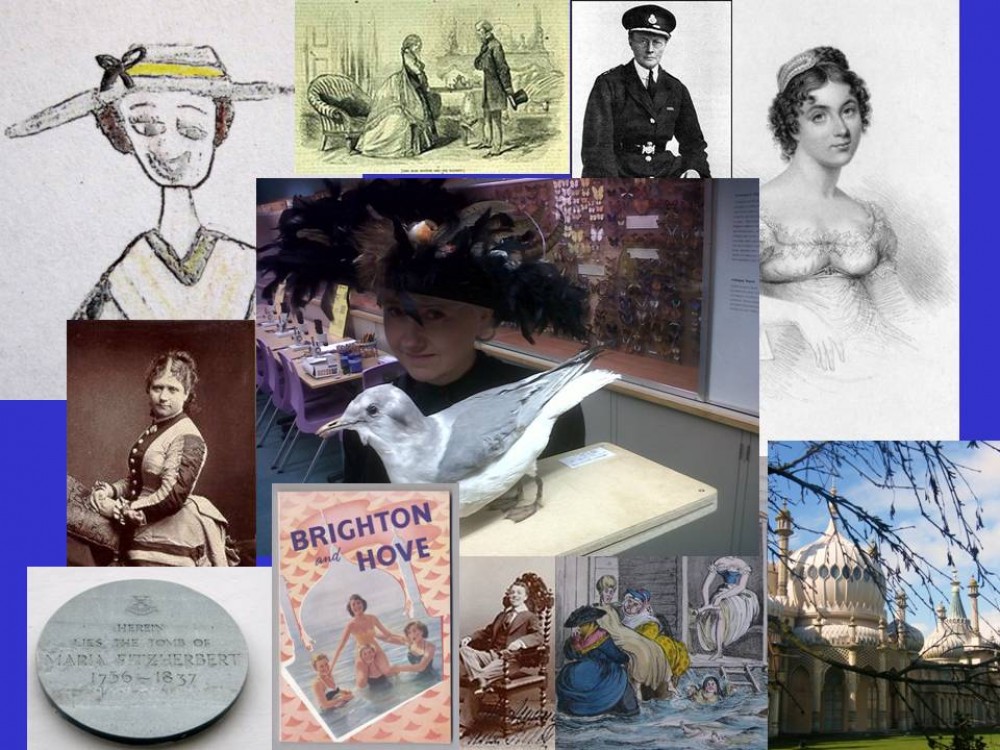
Women’s History Festival – Last Call

1

I’ve posted about this before, but it’s so good, I’m posting again!
Join us tomorrow, Saturday 14th March 2015, from 10 a.m – 6 p.m for Brighton’s first Women’s History Festival. The full programme and times are here http://freeuniversitybrighton.org/wp-content/uploads/2015/03/Brighton-Women’s-History-Festival-Schedule.pdf
barnsley-women-against-pit-closures-300x195

Talks at the Free University Brighton organised event include: The African Princess in Brighton – Brighton & Hove Black History Project, Women and the Mass Observation Archive – Suzanne Rose, Bad Girls: The Secret History of Women and Sexism – Louise Raw, “Prinny’s” Women – Jaki da Costa, Women and the Black Market in Post War Britain – Terry McCarthy and Women and the Miners Strike – Bev Trounce.
Guided walks – The Suffragettes of Brighton and Hove led by my colleague at Brighton Museum, Karen Antoni, and I will be turning my ‘Notorious Women of Brighton’ into ‘Amazing Women of Brighton’ for a walk at 2.30.
Workshops – Phenomenal Women: Creative Writing with Evlynn Sharp and Zine Making (Create your own women’s history ‘zine’ with historical materials from the National Archive) with Vicky Iglikowsky.
There’ll be two brilliant exhibitions, ‘Herstory’, an interactive women’s history exhibition by Alice Wroe – with activities suitable for children and, until 2pm, ‘100 Years of Women in Policing’ with Sussex Police.

PLUS – Film screenings, poetry readings, activities for children and young people, and food and drink available in the Brighthelm Café.

It’s taking place at the Brighthelm Centre http://www.brighthelm.org.uk/ North Road, Brighton,
BN1 1YD

See you there!

A Lady Poisons – The Case of Christiana Edmunds

poisoning_1

At the start of every Notorious Women of Brighton Walk I always tell people not to expect a parade of role-models, that some of the women I’ll be talking about haven’t earned their place on the tour through doing good works and achieving great things.  Christiana Edmunds, Brighton’s famous chocolate murderer, is a case in point.  In 1870 and 1871 the hitherto respectable Christiana struck terror through Brighton when she took a liking to lacing chocolate creams from the famous Maynard’s sweet shop on West Street (near today’s Waterstone’s) with strychnine.  These she sent anonymously in parcels to prominent people in the town.  Apparently, some she just took back to the shop, after injecting with poison, saying she’d bought the wrong chocolates and would like to swap.  In order not to arouse suspicion she slipped money to unwitting beggar children to go to the sweet shop for her.  Police in the town were nonplussed and at a loss to explain why noteable Brightonians were suddenly receiving these ‘gifts’.  It wasn’t until the four year old Sidney Barker died from eating one of the contaminated chocolates that the finger of blame at last came to rest on Christiana’s head.  Her motive, apparently, was revenge.  After Dr Beard, the married doctor with whom she was having an affair, decided to finish things, what better way to get back at him than poisoning his wife?   Maybe she roped in the others to create a smokescreen or just discovered a taste for poisoning and couldn’t stop herself.

christiana_edmunds_2_s

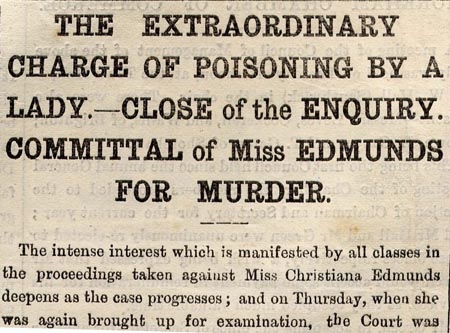
Do we seek to explain her motives because she’s a woman?   Would we be looking into her background and trying to analyse the choices she took if she’d been a man?  It certainly seems that her gender and the fact that a woman (a woman!) could do such harm kept the Victorian public riveted through her murder trial at the Old Bailey in 1872.  See the headline above ‘The Extraordinary Charge of Poisoning by a Lady’, that ‘Lady’ the most attention grabbing factor in the business. The Victorians loved stories of true crime and we can only imagine the extra frisson a female perpetrator would have added to this already smouldering cocktail of lust, forbidden love and jealousy.  Christina was found guilty of murder but, being declared insane, managed to avoid the death penalty, finishing her life at Broadmoor, then a criminal lunatic asylum, until her death in 1907. In a daily mail online article Tony Rennell writes  ‘she was one of the most notorious inmates of Broadmoor in Victorian times, her name a byword for something that hidebound era found impossible to comprehend or forgive — a woman’s unbridled lust.’

Kate Elms tells Christiana’s story on the Brighton Museum website  http://brightonmuseums.org.uk/discover/2011/02/14/death-by-chocolate/ and also on the website of the Keep http://www.thekeep.info/notes-collections-passion-poison-criminal-trials/

Women’s History Festival – Line Up Announced!

2716338-300x227

A few posts ago I mentioned that I was helping Ali Ghanimi of the Free University Brighton (http://freeuniversitybrighton.org/) put together Brighton’s first ever Women’s History Festival.  Well, the day will be going ahead on Saturday 14th March 10 – 6pm at the Brighthelm Centre on North Road  and is shaping up to have a great line-up of talks, walks, children’s activities and workshops.   Such as…

The African Princess in BrightonBrighton & Hove Black History Project

Women and the Mass Observation Archive – Suzanne Rose

Bad Girls: The Secret History of Women and Sexism – Louise Raw

“Prinny’s” WomenJaki da Costa

Women and the Black Market in Post War BritainTerry McCarthy

Grace Eyre Woodhead – Jackie Reeve

Women and the Miners StrikeBev Trounce

Clementina BlackGerry Holloway

I will be doing my ‘Amazing Women of Brighton’ walk.  And there’ll be a chance to catch Karen Antoni’s popular Brighton and Hove Suffragettes Walk.

Workshops will include:

Phenomenal Women: Creative Writing with Evlynn Sharp

Zine Making with Vicky Iglikowsky
Create your own women’s history ‘zine’ with historical materials from the National Archive

Surrey and Sussex Police will be presenting the exhibition ‘100 Years of Women in Policing’ and there’ll also be ‘Herstory’, an interactive women’s history exhibition by Alice Wroe with activities suitable for children.

Plus more!

Says Ali: ‘The one-day event will mark International Women’s Day celebrations and launch a year-long women’s history project to promote positive female role models within schools and the wider community.  It will feature fascinating, hidden histories of extraordinary and pioneering women such as Brighton and Hove suffragettes, the African Princess in Brighton and women who inspired the trade union movement.’

CAN YOU HELP?

The event is being crowd-funded.  We are trying to raise £1000 to ensure that it is free and accessible to all.  Any donations would be very gratefully received here  http://www.crowdfunder.co.uk/brighton-womens-history-festival

Thank you!

One Small Step. Helena Normanton: A Woman We Should Know Better

Ovingdean church

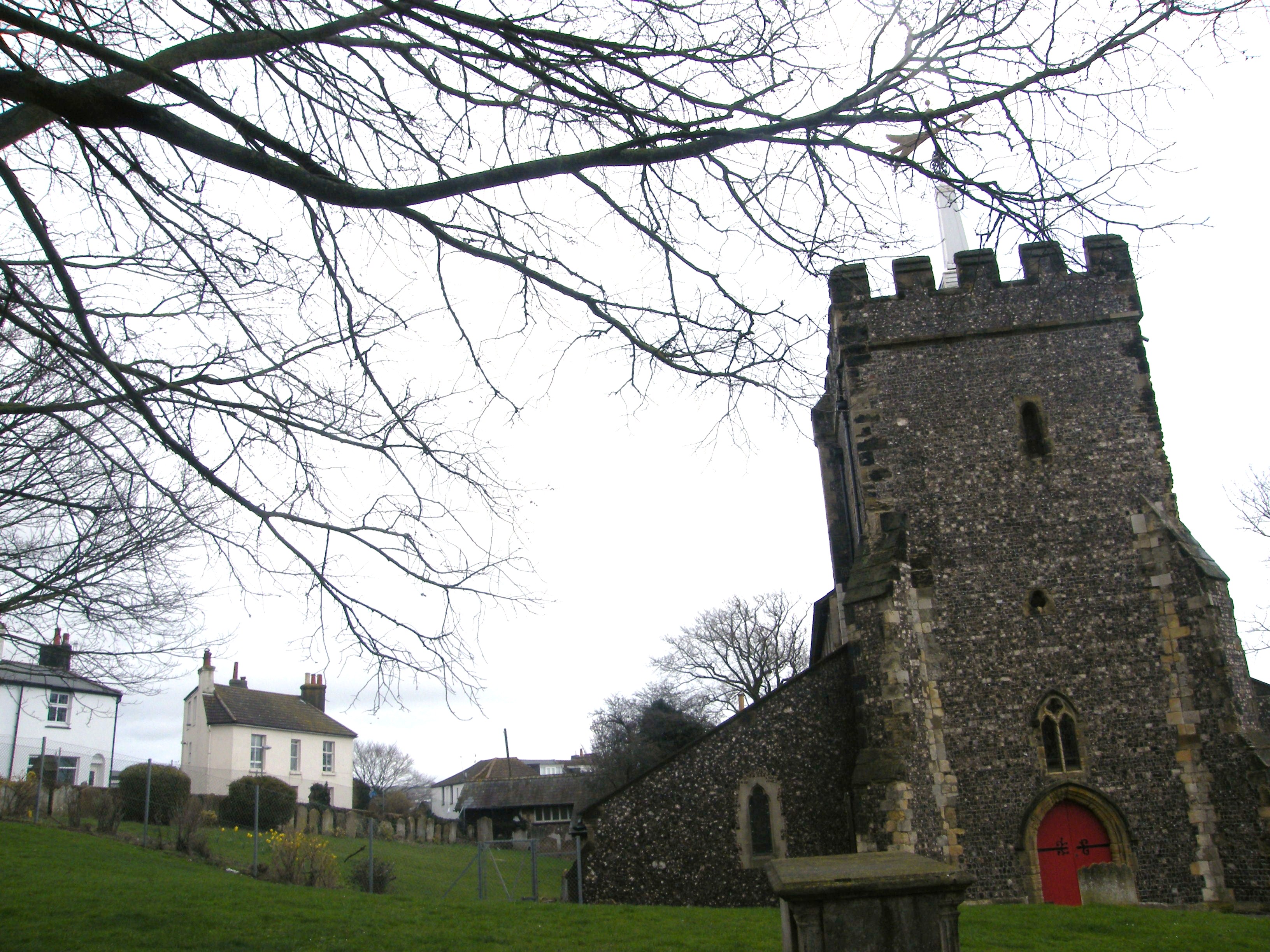
I wasn’t thinking much about historical women as I stumbled – literally, thanks to the icy wind and having just walked through a field of horses (I have a history of being chased by animals in fields while out walking, but that’s another story) – into St Wulfran’s Church at Ovingdean yesterday.  This early Norman church on the rural fringes of Brighton is a real gem.  Tucked away in one of the folds of the Downs, it has a gorgeous 1867 Arts and Crafts inspired ceiling by Charles Eamer Kempe, some beautiful stained glass and, thanks to posters advertising children’s groups, meetings and a stack of coffee mugs, the feel of a place that, despite being almost a thousand years old, plays a lively part in the community.   Picking up one of the leaflets provided for passers-by, I was intrigued to find that one of the most trailblazing women to be associated with Brighton – if not, of the twentieth century – is buried in the churchyard.

Helena_Normanton

This is Helena Normanton (1882 – 1957), the first woman to practise as a barrister in England and the second, in 1922 to be called to the Bar in England and Wales.   Her list of firsts doesn’t end there:  Helena Normanton became the first woman to obtain a divorce for a client, the first woman, in 1948, to lead the prosecution in a murder trial, the first woman to conduct a trial in the USA , and the first woman to represent cases at the High Court and the Old Bailey.   According to Judith Bourne, Senior Lecturer in Law at London Metropolitan University (http://www.edgehill.ac.uk/news/2011/02/the-legacy-of-helena-normanton/) “she left behind a legacy…In a way she was a social experiment and bore the brunt of discrimination for everyone else. A pioneer who fought against a lot of prejudice, she was the one who made it possible for women to enter the legal profession.”

Here’s yet another first… These days not many people blink an eye when a married woman chooses to keep her own surname.  But in 1924 the married Helena Normanton attracted considerable interest – and disapproval, no doubt – when she became the first married woman to be granted a passport in her maiden name.

helena n

Helena Normanton’s early life perhaps prepared her for the struggles to come.  At the age of four, her father having been found dead in a railway tunnel, she moved from London to Brighton with her mother and younger sister to run a grocery shop and then a boarding house in Clifton Place.  In 1896 she won a scholarship to York Place Science School, forerunner of Varndean School for Girls, but on the death of her mother only four years later, had to leave to look after her sister and help run the business.  1901 sees her moving to Hove, to live at a boarding-house in Hampton Place run by her aunt. In 1903 she was able to resume her studies and went to the Edge Hill Teachers’ Training College in Liverpool, subsequently teaching history in Glasgow and London before applying to become a student at Middle Temple in 1918.  Initially she was refused, and lodged a petition with the House of Lords, only being admitted in 1919 after her reapplication within hours of the Sex Disqualification (Removal) Act 1919.

As probably expected from a woman who was making such bold raids into male territory, Helena wasn’t an armchair supporter of women’s rights.  She joined the Women’s Social and Political Union (WSPU), and was part of the 70 women who, disenchanted with the leadership of the Pankhursts broke away to form the Women’s Freedom League.  She supporting the campaign of the Women’s Peace Council for a negotiated peace during the First World War and was an early member of CND.

Equality of pay was another issue close to her heart.  Despite having a successful legal career, she had to supplement her income by letting out rooms in her house and writing for newspapers and magazines to make ends meet.   She had lived through the First World War and seen women becoming the main breadwinners.  As early as 1914 she asked in a pamphlet ‘Sex Differentiation in Salary’ ‘Should women be paid according to their sex or their work?’ I wonder what she’d think if she knew that almost 60 years after her death, this issue that she described in such black and white terms should still be something that many women are fighting for.

Helena Normanton also campaigned for women’s rights within marriage.  She believed that, once married, men and women should be seen equally and in the 1930s campaigned for changes in the matrimonial law to allow married men and women to keep their money and property separately.  In 1938, despite hostility from the Mothers’ Union, she co-founded with Vera Brittain, Edith Summerskill and Helen Nutting, the Married Women’s Association in 1938.

On the website http://www.first100years.org.uk/ which explores the ‘journey of women in the legal profession over the last 100 years’ Kitty Piper writes ‘As one scholar puts it, Normanton should be to women lawyers what Neil Armstrong is to astronauts, and this is no exaggeration.’

Another reason we in Brighton should celebrate this incredible woman – Helena Normanton was the first benefactor to donate funds for the establishment of the University of Sussex.  Quoting the University website http://www.sussex.ac.uk/alumni/getinvolved/legacy ‘Helena Normanton campaigned tirelessly to establish a university in Brighton. She made the first donation to the Sussex University appeal in 1956, and bequeathed the capital of her trust to the foundation of the University upon her death in 1957.  ‘I make this gift in gratitude for all that Brighton did to educate me when I was left an orphan’Helena Normanton, 1956

Sharp-eyed, women’s history savvy visitors to St Wufran’s may also notice that the churchyard houses the family tomb of another pioneering woman with local connections, Sophia Jex-Blake (1840 – 1912), below, was one of the first female doctors in Britain.  I talk about Sophia on my Notorious Women of Kemptown Walk.  The tomb belongs to her family, Sophia Jex-Blake herself, was buried at Rotherfield alongside her partner, Margaret Todd.

Jex-Blake_Sophia

For more information about St Wulfran’s Church, see the website   http://www.stwulfrans.org.uk/

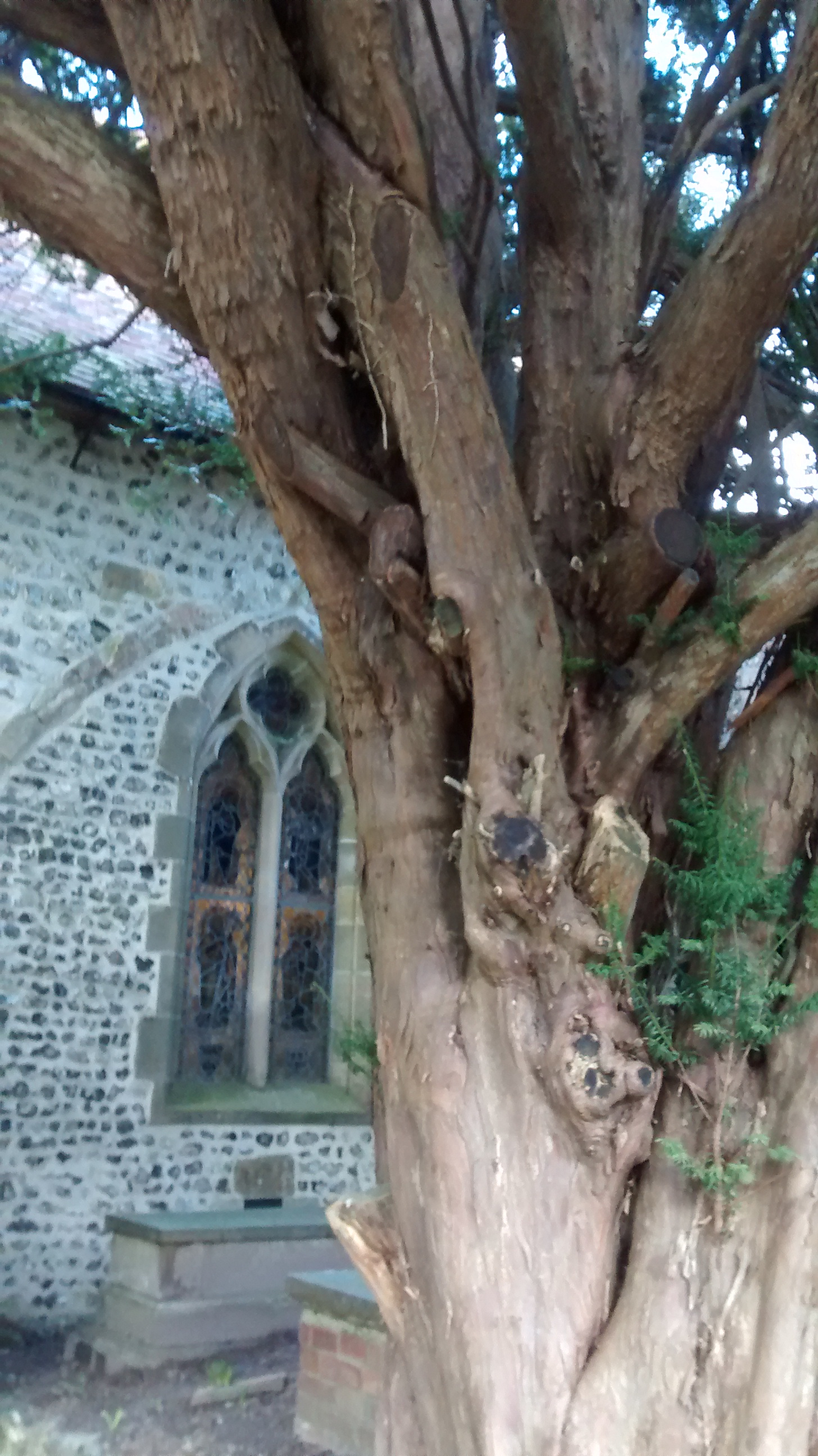
A thousand year old tree at the entrance to St Wulfran's Church, Ovingdean

A thousand year old tree at the entrance to St Wulfran’s Church, Ovingdean

More women please!

geograph-302412-by-Simon-Carey copyright – Simon Carey

This statue of Queen Victoria was erected at the end of Grand Avenue, Hove, in 1897 in commemoration of her Diamond Jubilee.  Have a good look at it.  Because it’s the only statue of a woman in Brighton and Hove. Last week Brighton’s local paper, The Argus, published an article here
http://www.theargus.co.uk/news/11633396.Plea_for_more_women_on_blue_plaques/ about the lack of recognition for women who have shaped our history.  Only a quarter of blue plaques in the city commemorate women.  The article says: ‘Ali Ghanimi, of Free University Brighton, and blogger and history guide Louise Peskett hope to raise public awareness of women forgotten by history.’  I am in my third year of doing guided women’s history walks of Brighton.  I know from all the surprised faces and ‘well, I never knew that’ and ‘this is so weird I’ve never heard of this woman’ comments that the key word here is ‘forgotten’.

And what about blue plaques?  They’re all well and good but they’re all about the past, aren’t they? I mean, it’s nice to remember the great and the good but, really, it’s only a bit of metal that looks like a blue dinner-plate, is it that relevant these days?  Absolutely.  I’ll hand over to Ali here: ‘“Telling stories about women’s achievements is a very powerful way to improve girls’ confidence and sense of place in the world,’ she says. ‘It counters harmful stereotypes and helps boys develop more respect for girls and women, which benefits all of us”.  Self-respect and having positive role-models have never been so relevant or important.  And not just for young people.  Are we ever too old to feel gladdened by and inspired by others’ achievements? Celebrating people is as much to do with today and tomorrow as yesterday.

This is why Ali – with some tentative help from me and a handful of other local women – is organising the first Women’s History Event in Brighton next March.  It’s built on Ali’s course at the Free University (http://freeuniversitybrighton.org/), ‘Women, the Greatest Story Never Told’.   Watch this space and expect speakers, workshops, tours and a club night plus more.  It’s shaping up to be an exciting day.  More details to follow as they come in.

This is one of the 21 women commemorated by a blue plaque in Brighton, Dame Anita Roddick, businesswoman, human rights activist and environmental campaigner, best known as the founder of The Body Shop.
anita r

Queen Victoria and the African Princess

1. St N church

St Nicholas Church, built in the middle of the 14th century, is one of the oldest buildings in Brighton. It has also seen its share of some of our city’s most interesting women. In 1726 a baby called Martha Killick was christened here. She was later to find fame as Martha Gunn, the most successful of Brighton’s formidable bathing women who reigned supreme during the craze for wealthy Londoners, the Prince Regent among them, to take the fashionable sea water cure in Brighton.  89 years later Martha was buried right there in the churchyard in a shady plot that happens to be –  appropriately for the ‘Queen of the Dippers’ – on one of the highest pieces of ground. Not far from Martha’s grave is that of the legendary Phoebe Hessel who, aged 15 and disguised as a man, ran away to join the army.  Phoebe managed to lead a military career for 17 years until a bayonet wound revealed that she was a woman, leading to her services as a soldier being swiftly dispensed with. In more recent years, Flora Robson, one of the most iconic British actresses of the twentieth century, known locally as much for her charity work as her acting, spent the later years of her life at nearby Wykeham Terrace and was a regular member of the church’s congregation. I’d be surprised, however, if any visitor to St Nicholas Church, caused quite as much of a stir as a certain Sarah Forbes Bonetta, whose wedding ceremony was held here in August 1862. Sarah was as close to the heart of British upper-class society as it was possible to get, having been virtually adopted at an early age by Queen Victoria. But don’t let her typically English name fool you, because Sarah Forbes Bonetta was from Africa.

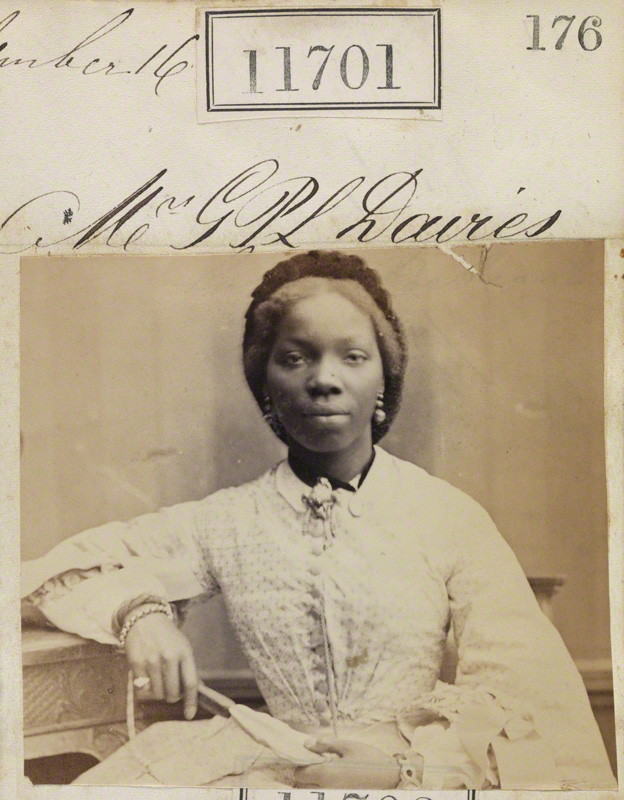
NPG Ax61384; Sarah Forbes Bonetta (Sarah Davies) by Camille Silvy

It’s thought that Sarah was born in 1843 in what is now southwest Nigeria of royal blood. Aged eight she was orphaned in inter-tribal warfare and captured by slave raiders. When she was found by Captain Frederick Forbes of the Royal Navy, she was a prisoner of King Gezo of Dahomey, who, according to American website http://www.blackpast.org was ‘the most notorious slave trading monarch in West Africa in the early 19th century.’ Captain Forbes had been sent to Dahomey by the British government in an attempt to persuade King Gezo to give up slave raiding and trading. When he came across the 6 year old Sarah – known as ‘Ina’ – he persuaded King Gezo to release her by suggesting that she would make an excellent ‘gift’ for Queen Victoria. ‘A present from the King of the Blacks to the Queen of the Whites’ was how he put it, thereby securing her rescue. Before setting sail for her new home, the girl was baptised Sarah and given Forbes’s surname,  ‘Bonetta’ coming from the name of his ship. Forbes wrote in his diary that his young charge was a ‘perfect genius… far in advance of any white child of her age in aptness of learning, and strength of mind and affection…’ Sarah’s first meeting with Queen Victoria took place on November 9th, 1850 at Windsor Castle. She would have been aged about seven or eight. What on earth would such a young child, African born, and having spent the last couple of years of her life as a captive of slave traders, have made of suddenly being launched into the heart of regal pomp and power in England on a cold November day? Queen Victoria, who always took a shine to genuinely talented people, instantly liked Sarah, declaring herself impressed by her regal manner and intelligence. Following Captain Forbes’ death in 1851, the Queen entrusted Sarah to the care of a family in Gillingham, paid for her education, and regularly welcomed her at Windsor Castle where she delighted in her company and musical talent. When Sarah developed a cough a year later, concerned that the English climate wasn’t good for her health, she arranged for her to continue her education in Sierra Leone. In 1855, however, despite excelling academically, Sarah chose to return to Britain and the care of her unusual god-parent. In August 1862, not long after attending the wedding of Queen Victoria’s eldest daughter, the Princess Royal, Sarah was given permission to marry Captain James Pinson Labulo Davies, a 31-year-old Yoruba businessman from Sierra Leone who was based in London. There are a lot of websites telling Sarah’s story and many question whether ‘permission’ in this case would be better described as ‘pressure’ because it seems that, initially, Sarah’s interest in Captain Davies’ proposal was lukewarm. If she was as academically gifted as described, and having had the best education (for a woman at the time) that it was possible to have, it’s tempting to think that the life of a respectable and subservient Victorian wife wasn’t such an attractive destiny. Living through the dramatic events of her childhood and then being thrown into a completely different culture must have made her a resourceful and practical young woman. I wonder if she saw a more useful outlet for her remarkable skills? While deliberating on her choice she was sent to stay with a couple of older women in Clifton Street, Brighton. Whether this was a deliberate gesture to persuade the twenty-year old Sarah of the virtues of making a respectable marriage, the wedding went ahead. It must have been one of the most elaborate ceremonies ever seen in Brighton at the time. No less than ten horse-drawn carriages transported the wedding party, complete with sixteen bridesmaids, from West Hill Lodge to St Nicholas Church. The Brighton Gazette describes watching the procession of ‘White ladies with African gentlemen, and African ladies with White gentlemen’.

Mr_and_Mrs_Davies

This photo of Sarah and her new husband was taken just a month after the wedding by French photographer, Camille Silvy, a popular photographer of the royal family, in his London studio. The couple went to live in Sierra Leone where Sarah worked as a teacher (hopefully finding a fulfilling outlet for her skills). Queen Victoria gave her permission to call her first daughter Victoria, and became her godmother. In 1867 Sarah returned to England with her young daughter and the Queen took immediately to her namesake, pledging to support her education. Sarah and her husband had two more children and moved to Lagos, Nigeria. Unfortunately, in 1880, while only in her late thirties, this talented and clever woman, whose life had been so eventful, succumbed to tuberculosis and died on the island of Madeira. Queen Victoria continued to support and take a real interest in the achievements of the young Victoria (below), who like her mother, was a talented musician and was a welcome visitor to the royal household for the rest of her life.

victorialarge

I have Brighton and Hove Black History to thank for reminding me of the story of Brighton’s African queen. I bumped into Bert Williams of Brighton and Hove Black History just the other day at the Museum’s War Stories Open Day. I’m always pleased to see Bert as he’s a treasure trove of local history. He’d brought along some really interesting panels that told the story of the 16,000 men, two-thirds from Jamaica, who came from the Caribbean to fight in the First World War, many forming the British West Indian Regiment in Seaford in 1915.  Sarah Forbes Bonetta is one of the people featured on the Brighton and Hove Black History leaflet. To find out more about Brighton and Hove’s black history, go here http://www.black-history.org.uk/index.asp

Here’s another great link – 10 minute footage of Kamal Simpson talking to Clare Gittings, Learning Manager at the National Portrait Gallery, about Sarah. http://www.youtube.com/watch?v=R4R3_Y0Rb1g
9_sarahbon

An Afternoon with the ‘Gentlemen in Khaki’

BxZ3G4RCUAA-i29

Some days I really love my job.

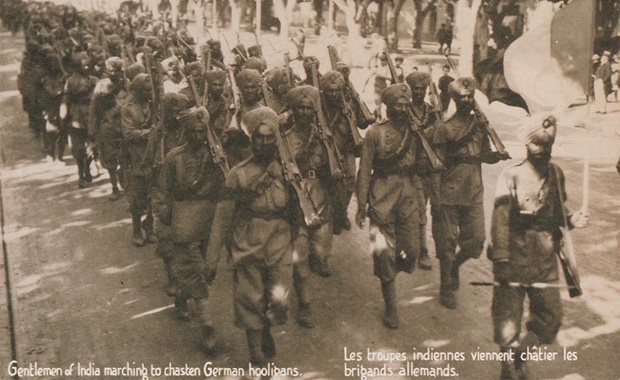
My mission on Saturday 13th September: take the 15th Ludhiana Sikh regiment on a tour of the Royal Pavilion. It wasn’t supposed to work out like that. I’d been hired to be Brighton Museum’s French speaking meet and greet for its War Stories Open Day, a real pic n mix of an event where visitors could research their First World War ancestors, listen to poetry and prose inspired by the conflict, hear wartime songs, rub shoulders with costumed characters, have a suffragette explain to you just why women should be given the vote, get close to military uniforms and kit, and generally find out more about how the years 1914 – 18 were experienced by the people of Brighton. With the hordes of French visitors conspicuous by their absence, however, and my paper Tricolor quickly wilting, it was decided to find a better use of my time. And what better use… The gentlemen in question, although looking as if they’d just stepped out of a time machine from 1914, were from the National Army Museum, part of a living history project in conjunction with the Anglo-Sikh Heritage Trail called ‘War and Sikhs: Road to the Trenches’ ‘http://www.nam.ac.uk/microsites/future/join-in/nam-about-town-country/war-sikhs/ . Made up of volunteers and staff from the National Army Museum, its aim is to ‘bring the Sikh military story to life’ by recreating a formation of soldiers from the 15th Ludhiana Sikh Regiment as they would have appeared on the battlefields of the First World War. This contemporary postcard shows them arriving in France… 128752

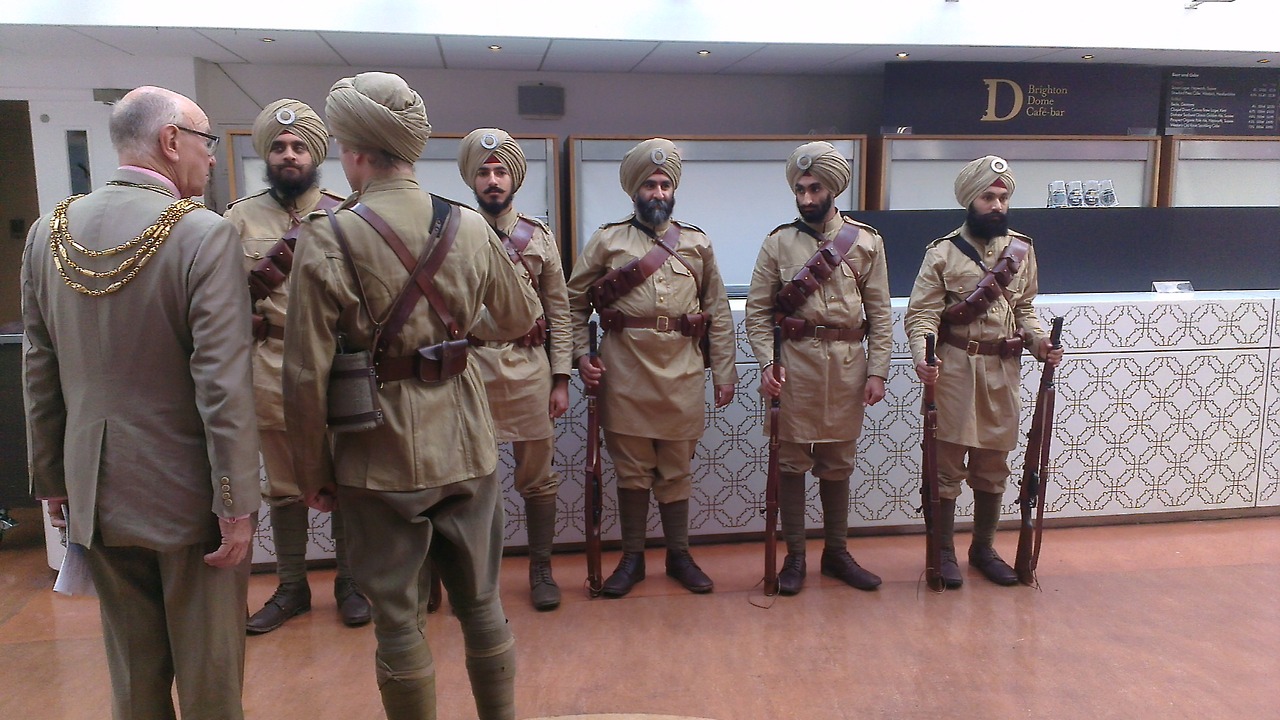
(Note the caption in French and English… ‘Gentlemen of India, marching to chasten German hooligans’.)  I’ve mentioned on this blog before that 1.3 million Indians fought in the First World War, 20% of them Sikh. The Brighton connection, of course, is that the Royal Pavilion Estate, as well as other premises in the city, became military hospitals for the wounded. Here’s a picture from the Royal Pavilion and Museum’s tumblr ‘A War Story A Day from Brighton Museums’ http://brightonmuseums-ww1-war-stories.tumblr.com/ of our ‘soldiers’ being greeted by the Mayor in the Dome… tumblr_nbuguftfdO1trdkk1o1_1280

As I crossed the gardens from the Museum to the Royal Pavilion with the ‘gentlemen in khaki’ as the local newspapers were fond of calling them, I felt more like a celebrity minder. Camera phones clicked, flashbulbs popped, heads turned and jaws dropped as we made our inevitably slow progress across the few metres of path. It’s not every day, after all, that you see a regiment of Indian soldiers in full battle dress among the buskers, EFL students and sunbathers who throng this part of town on a sunny afternoon. ‘Uncanny’ was how I’d describe giving a guided tour to these very special visitors. For years I’ve done talks and tours about the use of the Royal Pavilion as a military hospital and I’ve spent hours poring over old black and white photos of Indian patients recovering in the gardens, sitting in beds in the Banqueting Room, posing in regimented lines on the lawns. To suddenly have these photos come to life, the characters from them slipping out of the frames and walking around, asking questions and patiently listening to me tell them about George IV and how many crystals are in the Banqueting Room chandelier, was one of the oddest experiences of my working life. (‘Uncanny’ is probably the word they’d use for my guiding style too… Lots of ‘ums’ and ‘ers’ as I tried to remember whether I’d fallen down some kind of rabbit hole, Alice in Wonderland-style, and been transported back one hundred years.) The spell was only broken when in the Music Room we happened upon a bride and groom posing for wedding photos and one of the ‘soldiers’ cheekily observed what a great photo-bombing opportunity we had. (We didn’t. Although the bride and groom didn’t look as if they’d have minded if we had). After having a look round the ground floor and sharing some of the inevitable Royal Pavilion wow moments, we went upstairs to spend some time in the Indian Military Hospital exhibition gallery where we all stood watching the crackly and silent 1915 film footage of George V and Queen Mary presenting medals to some of the injured soldiers in August of that year, one of them being Sebadar Mir Das, awarded the Victoria Cross for his courage at the second Battle of Ypres. We made the discovery that the displayed souvenir book produced by the military authorities in 1914/15 for the patients featured a soldier from none other than the 15th Ludhiana Sikh regiment on the cover.

. souvenir

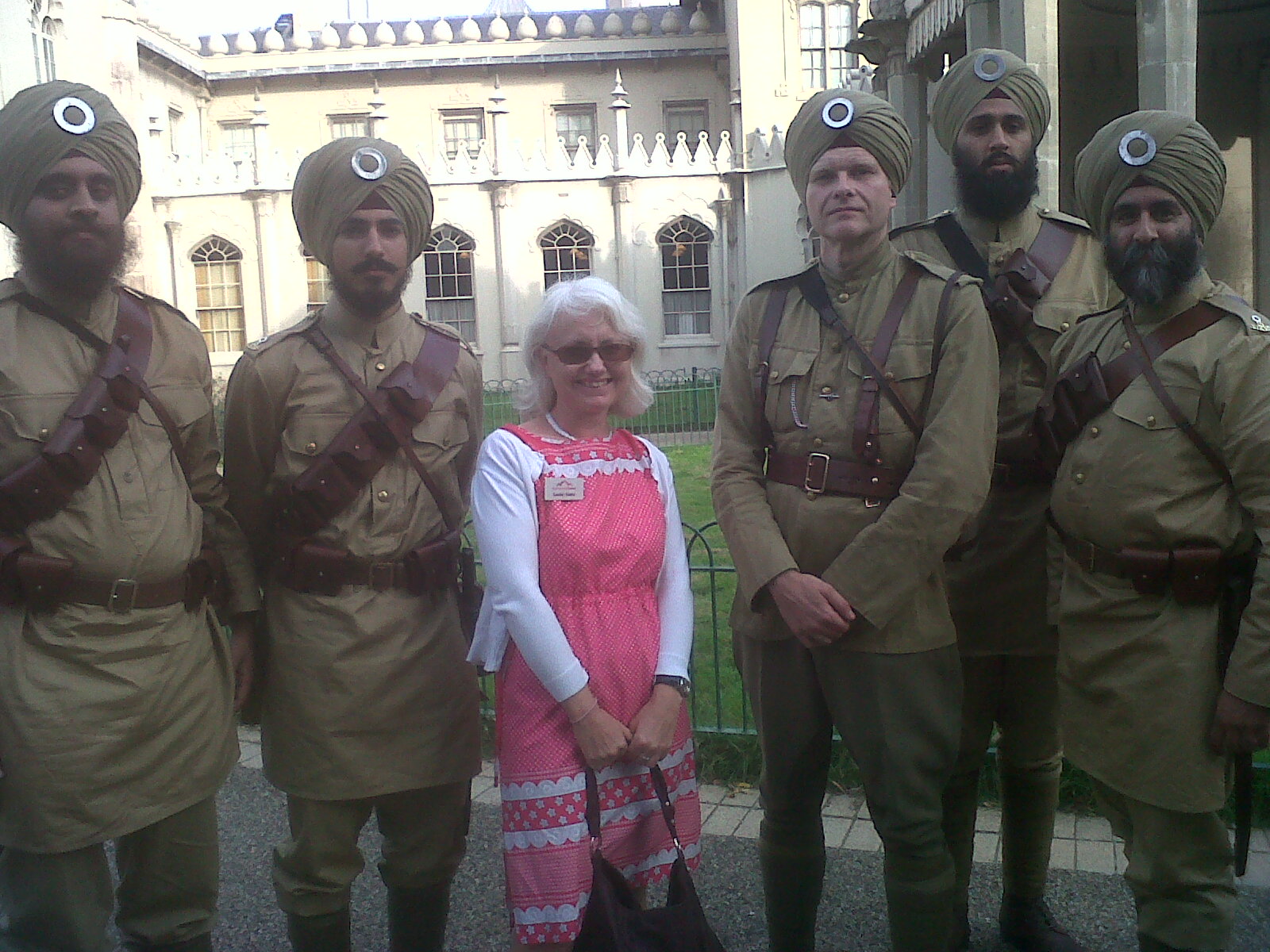
For one of the volunteers, Kuljit Singh Sahota, bringing this part of the past to life had a particularly personal significance. His great great grandfather was Manta Singh, a member of the (real) 15th Ludhiana Sikhs, who was fatally injured while wheeling a fellow soldier to safety in a wheelbarrow during the Battle of Neuve Chapelle, and whose story is featured in the Museum’s current War Stories exhibition. Read more about Manta Singh here http://www.cwgc.org/foreverindia/stories/manta-singh-neuve-chapelle.php.  Then it was outside once more for interviews, photos and filming. Celebrity minding time again. The people of Brighton, not known for their shyness, quickly mobilised around us. ‘Who are you?’ ‘What are you doing?’ ‘Wow, they look fierce! I wouldn’t like to get on the wrong side of them.’ Hands were shaken, backs patted, and selfies with an Indian soldier became the hottest ticket in town. Ahem.

Brighton_and_Hove-20140913-00221 (2)

‘This might take some time,’ I thought as a coachload of Italian teenagers passing through the gardens suddenly congregated around us and a man with green hair and a Sex Pistols T-shirt took it upon himself to start relating the story of the Royal Pavilion’s past as a military hospital to passers by, soon ending up with a crowd around him. ‘What’s going on?’ some French tourists (arriving late for my meet and greet, no doubt) were heard to ask. ‘It’s sort of street theatre and public lecture all at the same time,’ someone suggested. I couldn’t help noticing that some of the people who were asking questions and chatting to us were definitely not going or coming back from the Museum’s War Stories Open Day. What a great example of how props, costumes and living history can reach out to the places museum exhibitions can’t. Impromptu Q and A sessions abounded. One of the things that I found out about was the point of ‘putees’, i.e. the thin strips of cloth worn tightly around the lower leg, like these… puttees

When tied with sufficient tightness, they strengthened the leg and helped support the considerable weight of the equipment that had to be carried. And no, contrary to appearances, they don’t get soggy in the rain. Made of very finely knitted wool, they protected the lower leg from moisture, would dry easily, and stopped boots disappearing into mud.  As the afternoon drew to a close and evening fell, it was time for some last photos on the east lawns in front of the building before the party finished their day at the Chattri (the site on the South Downs where the Hindu and Sikh soldiers who lost their lives in the Brighton hospitals were cremated, now marked by a white marble memorial,) As the sun went down and a hazy sepia tinted light fell, the 15th Ludhiana Sikhs lined up for a very formal, straight-backed, military portrait. It was easy, again, to forget we were in the twenty-first century …Until a local man, caught napping in the grass in front of them suddenly woke up. ‘Oops, sorry, do you want me to move, mate?’ ‘That’s OK, one of the Indian soldiers called across. ‘We can photoshop you out.’ I learnt a lot that day, not least about how far costumes, props and simply getting out and about and talking to people can make history approachable and user-friendly. Thanks to the 15th Ludhiana Sikhs for their company and sharing their knowledge, as well as for providing possibly the most surreal moments of my career. (And working in museums, there’s a lot of competition for those.) I will be leading guided First World War estate tours across the Royal Pavilion Estate – and probably won’t be able to stop myself from talking about this – on October 18th, November 8th and December 27th starting at 10.30. I’ll be joined in guiding duties by my colleague, Paula Wrightson, and one of the Dome’s brilliant event managers who will take us behind the scenes in the Dome and Corn Exchange to explore further how these buildings were used during the war. For information, 03000 290900.

Thanks for bearing with me with this post and its lack of historical Brighton women, by the way.   Many, many more of our fantastic local women to follow shortly…

In Praise of Peggy Angus

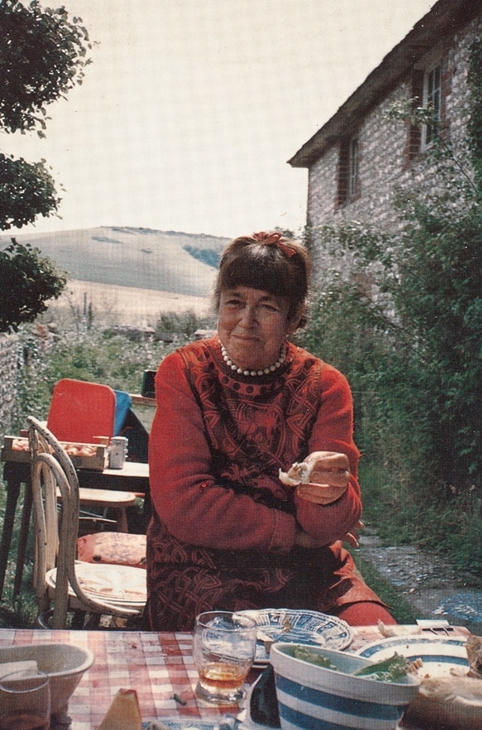
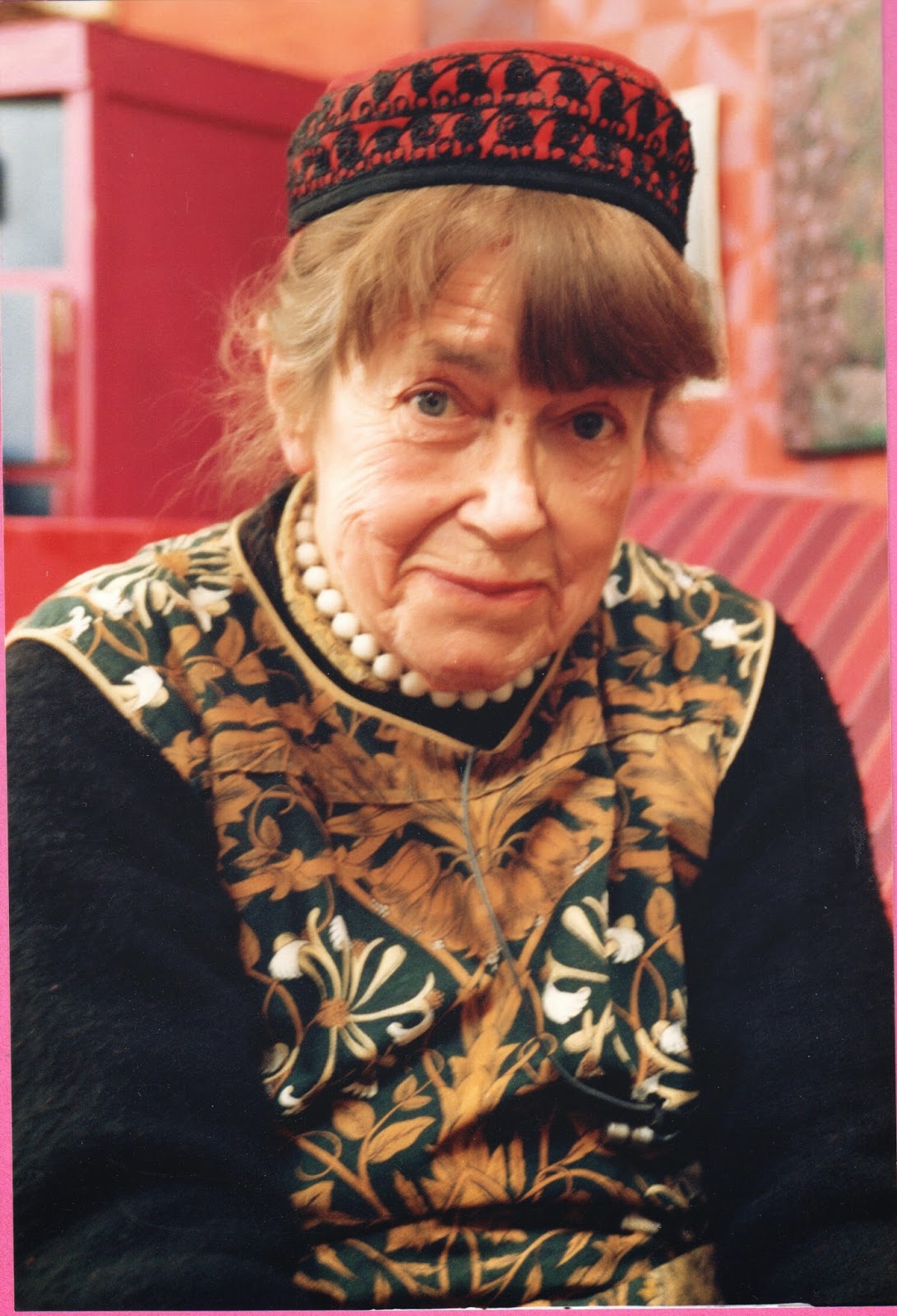
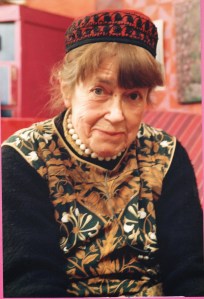
I went to the Towner Gallery in Eastbourne last week and was baffled to discover a fantastic female artist who seems to have dropped out of conventional art history. The quite startingly good exhibition, ‘Peggy Angus: Designer, Teacher, Painter’ http://www.townereastbourne.org.uk/exhibition/peggy-angus/   is only on until 21st September and if you are in any way within reach of Eastbourne in the next few days – or even if you aren’t – you really should go.  Peggy, although Scottish, worked locally, having bought a shepherd’s cottage called ‘Furlongs’ near Firle. The Sussex countryside is a robust and lively presence in her work, as much a part of her paintings as it was in her friend’s, Eastbourne artist Eric Ravilious, with whom she used to paint.  Her life and work and great generosity as an artist and woman deserve much, much more than the brief, potted resume I’m going to give here, but this is her basic story…

peggy_angus_05_660

Peggy (real name Margaret MacGregor Angus) was born in 1904 in Chile where her father was a railway engineer. Aged 17 and resettled with her family in Muswell Hill, Peggy won a scholarship to the Royal College of Art where her contemporaries numbered Barbara Hepworth, Henry Moore and Edward Bawden. She was taught by Paul Nash, who claimed she was the most obstinate student he’d ever taught.  With her brothers and father lost in the First World War it became apparent that, for Peggy, art could never be a luxury but a means to earn money. She trained to be a teacher and in the early 1930s, with one of her teaching jobs bringing her to Eastbourne, she decided to buy ‘Furlongs’, a ramshackle and primitive stone cottage without running water nestling in the South Downs (the story goes that the owner of the house, a local farmer, initially didn’t want to sell so Peggy just set up a tent and camped outside until he changed his mind a few months later). Furlongs was a weekend retreat where she immersed herself in painting lively scenes of the surrounding countryside, all frisky cattle, rat-catchers, threshing, and milking cows  ‘I like doing life, things happening,’ she says on a 1980s-filmed interview that runs in the exhibition ‘People doing things.’ Unlike Ravilious whose depictions of the exact same places are haunting, empty of people and isolated, making the landscapes of the South Downs oddly haunting and magical, Peggy’s show a version that is full blooded and immersed in everyday life, warts and all.  Peggy and Eric Ravilious, a frequent guest at Furlongs, would go out and paint together. They were both fascinated by the nearby Asham Cement Works (now demolished) and it’s interesting to see both artists’ depictions of this evocative landmark hung next to each other in the gallery, Peggy’s robust and in oil next to the wispy, wintry Ravilious watercolours. This is Peggy’s from 1934.
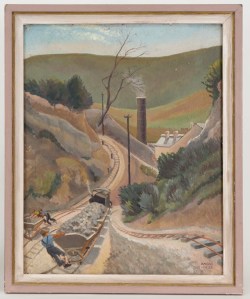
peggy
I am loving imagining the pair of them, lugging their easels over the Downs, perhaps sandwiches or a piece of cake wrapped in paper, the famously jocular Ravilious and Peggy who has been described as ‘eccentric’, ‘opinionated’, ‘difficult’ and ‘a warrior’. Did they argue over their different depictions and styles? Did they laugh?
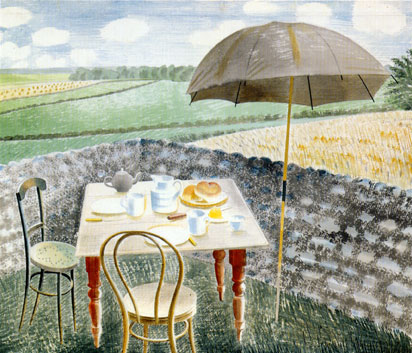
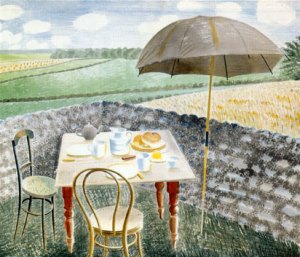
And here’s one by Ravilious from 1939, ‘Tea at Furlongs’ . Wouldn’t you just like to pull up a chair and pour yourself a cup of tea at that table?
Eric-Ravilious-Tea-At-Furlongs

I can’t resist adding this portrait of John Piper completed by Peggy in 1937, now in the National Portrait Gallery.
Peggy Angus John Piper

Those colours and shapes! I stood in front of this in the gallery and it seemed to glow.

Furlongs became something of an alternative Charleston. Not only Ravilious and his wife, the artist and engraver Tirzah Garwood, but also Herbert Read, Serge Chermayeff (co-architect of Bexhill-on-Sea’s De La Warr Pavilion), Brighton artist Percy Horton, John and Myfanwy Piper, painter and Bauhaus professor Laszlo Moholy-Nagy, among others, were frequent guests.  The Towner exhibition has recreated one of the rooms – a burst of colour, gorgeous wallpaper, murals and unmatching crockery. Remarkable that the two cradles of artistic talent, just a stone’s throw away from each other, didn’t seem to rub shoulders.  I get the impression – I might be wrong – that Furlongs was a whole lot less self-conscious, the ‘Coronation Street’ to Charleston’s ‘Dynasty’ perhaps. 

In the title to the exhibition the word ‘painter’ comes last after ‘teacher’ and ‘designer’. Beautiful as her paintings are, it’s really in the latter two that Peggy Angus made her most enduring mark.
Peggy was a fan of William Morris and believed that art and life were inseparable, that art could be found in the everyday and was at its best when it was by the people, for the people, a joy to the maker and user. A visit to the Soviet Union in 1932 with the Art Teachers Conference impressed her with that country’s equality for women and its discussion of art in the context of social history. (This visit impressed her so much she was known as ‘Red Peggy’ afterwards).  The impulse to use her talent for the good of society was strong.  Not only did she teach, gaining a reputation for coaxing talent from her pupils as well as a lifelong love and respect for the potential of art as a force for good, she also became an incredibly prolific designer, although this seems to have been accidental.  Post second world war, when art materials were in short supply, ever practical Peggy turned to potatoes, encouraging her students to experiment with potato printing.  One evening FRS ‘Kay’ York, one of the architects involved in the nationwide post-war reconstruction of schools and public buildings, came to dinner, saw the tiles and thought they’d make good murals. Peggy became a prolific and beautiful tile designer, her simple but starkly colourful  geometric patterns the perfect way to soften the hard materials and angular lines of the new buildings. .
peggy-tile

tiles

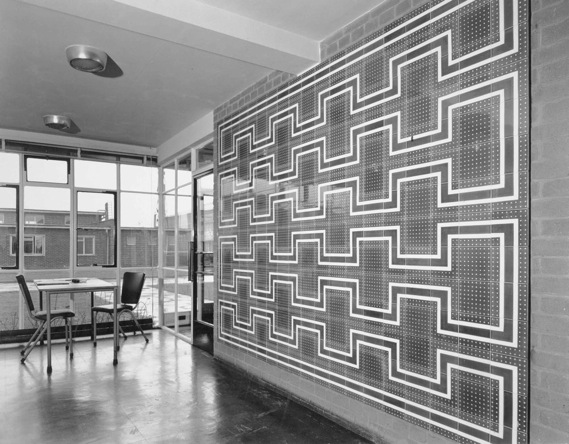
Her tile work (sadly no longer there) embellished, among many, many other places, the early Heathrow and Gatwick Airports. Below is what you could have enjoyed arriving at Heathrow in 1955.
tile mural

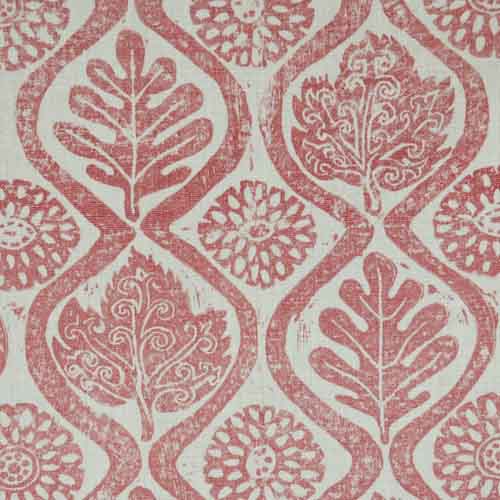
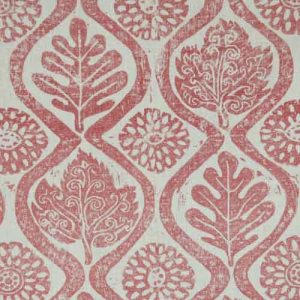
Peggy would draw the designs of the tiles onto paper and when her daughter suggested hanging some on the wall she had the idea of creating wallpaper. Like the tiles, these were often wonderful geometric patterns often in two shades of the same colour.  Ever practical again, she would design them in emulsion paint so clients would be able to mix and match them to their houses with ease.
wallpaper

I took a lot of things away from this exhibition. Mainly – why haven’t I heard about this woman before?  Perhaps the circumstances of her life – a single mother with two children meant that, unlike many of her male contemporaries who had the luxury of slipping off to places like Paris to find themselves and experiment for a few years, she had to work hard to earn money. She was never wealthy (apparently she was making the journey to Furlongs from London on the bus with a rucksack until old age).  She also had a social conscience which played a part, I think, in her spending a lot of her energy in sharing her talent, nurturing, encouraging, lighting sparks in other people (in her eighties she was running art classes for senior citizens in London). I came across this great article in The Observer http://www.theguardian.com/artanddesign/2014/jul/06/peggy-angus-warrior-painter-designer-tiles-wallpaper in which Rachel Cooke writes “Perhaps, too, her reputation, or lack of one, is connected to the matter of personality. For women of Angus’s generation, professional life was rarely anything less than a struggle: they were required to be tough and, as a result, often
seemed difficult. “She could be really rude to people,” says her daughter, Victoria. “Absolutely foul. She thought it was unfair, her life. She longed for a wife, for someone to do the cooking so she could get on with her work.”
This great generosity and sharing spirit comes out so well in the exhibition. I left with a spring in my step. All those colours, the busyness, the activity in her paintings, the beautiful tiles and wallpaper that would cheer and enrich any house, the fact that, in this artist’s hands, mere potato printing went on to adorn the walls of the world’s busiest airport, the Scottish folk songs from the interviewed film, Peggy’s voice singing out. Working in museums I see a lot of exhibitions but I left this one with a sense that life was a bit brighter.
peggyangusportrait

Good Housekeeping 1914

Fancy a piece of ‘Savoury Pudding’?
Savoury_pudding_1914_recipe

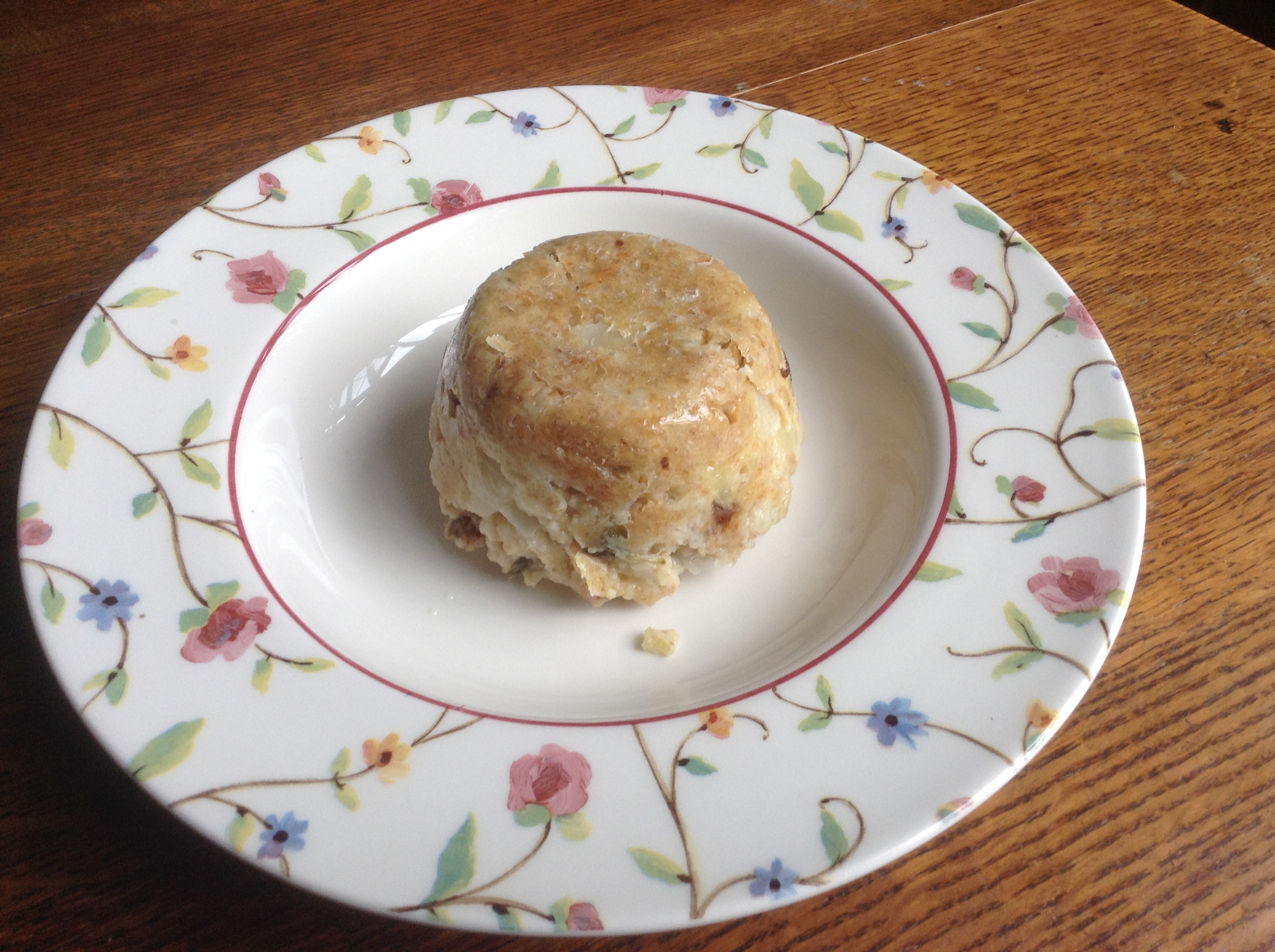
This optimistically named dish was made by Preston Manor Creative Programme Officer, Paula Wrightson, in her search for authentic, everyday meals eaten during the First World War. A stodgy and relatively cheap combination of oatmeal, flour, suet and eggs that must really not have left the 1914 diner wanting more, its flavour can be summed up, Paula says, as ‘astonishingly bland’. The pudding will be making a star appearance at Preston Manor every Friday in August from 8th as part of the ‘1914 House’ event, an intriguing house tour around the Manor which despite partly dating from the seventeenth century, lived through its golden years in the Edwardian period and was very much a functioning home during WW1. In 1914 the residents included Brighton power couple Ellen (below) and Charles Thomas-Stanford…
ellen
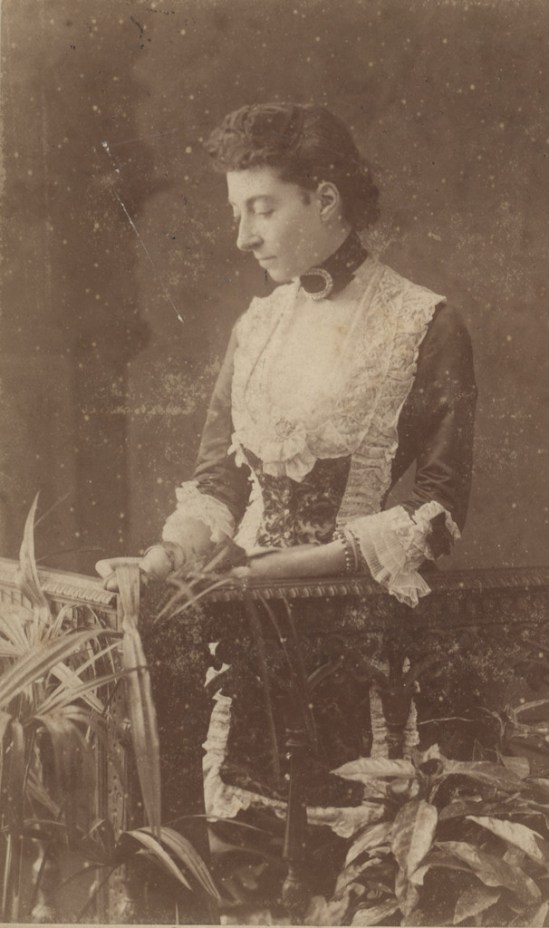
Charles was an MP and had been mayor. Ellen had inherited the Manor as well as the huge tranche of the town that made up the Stanford estate. The outbreak of the war saw them in Preston Manor with their 10 servants (photo below shows a handful of servants in 1920).
pm servants
By giving a close look at the residents of the Manor, their daily activities and the way they lived, the tour pieces together a fascinating picture of everyday domestic life that formed the backdrop of this most momentous year. If you’re interested in the little details – the small change of life, as it were – that tend to fall down the sides of the usual official histories with their dates and important events – this is for you. Not only food but cleaning products, grooming routines, toilet roll, toothbrushes, and the astonishing array of class A drugs that formed the acceptable and completely legal medicine cabinet are all covered with a vengeance by Paula and guide/lecturer Sarah Tobias. In her quest to leave no stone unturned, Paula has even acquired a bottle of the must-have perfume of the day (Guerlain’s L’Heure Bleue – “fragrance of bluish dusk and anticipation of night” – how grimly right Guerlain’s marketing people were in summing up the spirit of the times) that the wealthier women of the time would have aspired to.
l'heure
…So not only will we know what 1914 looked and sounded like but also what it smelled like. (Tasted like maybe not so much. In spite of what will no doubt be high demand Paula’s savoury pudding can be looked at but not eaten – sorry.)
What I like about the sound of this event is that it is so unashamedly domestic. At a time when the big things about the conflict – trench warfare, the politics, the technology, the harrowing statistics – are being widely covered, it’s easy to overlook that in Brighton, as in many other thousands of towns in Britain, some sort of life was having to go on as normal. People still needed to be fed, hair to be brushed, shoes to be polished, coughs and colds to be attended to. More often than not, this was still women’s work. We all know how the First World War flung women into the world of work as never before. Women were conducting trams, working in munitions factories, engaged in previously male territory such as farming and policing. All well and good, but, for the most part, they still had houses to run, children to care for, and the usual domestic chores that weren’t going to sit around and wait while they got on with their new ‘careers’. Juggling ever more responsibilities in ever straitening conditions (the cost of living rose by 87% between 1914 and 1915) – as well as holding down a job – probably didn’t feel like a great leap forward for the women struggling to keep the home fires burning. This tour I think will give us a glimpse of what it must have been like to stand in their shoes.

Through all this I can’t help thinking about my own great grandmother, Ellen Bramley from Birdwell, a mining village in South Yorkshire. Gentle, quietly-spoken yet uncannily steely (she remains the only person in the world who has ever succeeded in making me eat cabbage) she spent the war suffering in great penury as a single mother, taking in other people’s laundry and doing what work she could find. She didn’t lose her young husband on the battlefield but in one of the many mining accidents that happened with shocking frequency in South Yorkshire back then. I remember her house in the 1970s – her fridge always packed with bowls of dripping, tiny slivers of leftovers that she would never throw out, gravy made from the meat, home pickles and jams, plus the ubiquitous cabbage laid out on a plate as if for a banquet.
gran
Thanks very much to Paula Wrightson for the pudding photo and much of the information for this post.
‘1914 House’ takes place at Preston Manor, Preston Drove, Brifghton, BN1 6SD on Fridays 8, 15, 22, 29 August 2014 11am–12.45pm & 2–3.45pm £15. For bookings call 03000 290900
(NB. This post isn’t in any way an advert for the event. I’m writing about it because it just looks good!)
pm

World War One – Where were the women?

MUNITIONS_2685907c

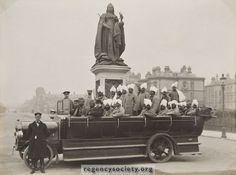
Brighton was an important town during WW1. Within weeks of war being declared in 1914, the town had made a sober transformation. Out were the ice-cream stands and the renditions of ‘I do like to be beside the seaside’ and in was a new very straight faced Brighton as it slipped into its new identity as one of the most important hospital centres in Britain. With its position on the coast, it was inevitable that, when space to care for the wounded ran out on the Western Front and the decision was made to ship the injured back to Blighty, Brighton would be an obvious choice. Not so obvious perhaps, the decision to change the former Prince Regent’s Pleasure Palace, The Royal Pavilion, as well as the 1,500 seat Dome concert hall and Corn Exchange into hospitals. But that’s what happened. In fact, the Royal Pavilion Estate became a 700+ bed, state of the art military hospital complex. (BHASVIC, Brighton General Hospital and several private residences also did their bit.) In a piece of thinking that today sounds like an episode of ‘Mind Your Language’ or ‘It Ain’t Half Hot, Mum’ (for any readers under 40, these are 1970s ‘comedies’ that relied heavily on racial and national stereotypes), it was decided to make these buildings, built in an Indian style, into hospitals for, yes, you’ve got it, Indian soldiers. This knowledge isn’t as common as it should be but 1.3 million Indians fought alongside Britain during WW1. During the early months of the war Indians made up 20% of allied forces. To be fair, the Royal Pavilion Estate functioned as well as could be expected as an Indian hospital. There were 9 separate kitchens to cater for the caste and religion driven dietary requirements, separate latrines, taps, bathing areas, facilities for worship, and carefully thought-out programmes of entertainment that included magic lantern shows, organ recitals, sports, games and trips to London. I love this picture, showing a party of Indian soldiers in a charabanc next to the statue of Queen Victoria in Hove.
indian soldiers
A colleague told me just the other day that they were going to Portslade. I would love to know what they were going to do there.
Between November 1914 and early February 1916, then, when the Indian divisions were redeployed to the Middle East, over 4,000 soldiers had received the attention of ‘Dr Brighton’. Local people didn’t see as much of their Indian visitors as they would have liked. A high fence was erected around the perimeter of the estate and any interaction with the patients was tightly controlled. The best anyone could hope for was to take a ride on one of the double-decker trams that ploughed the Old Steine outside and try to peer over the side. This picture shows the Banqueting Room converted into a hospital ward.
rpe
Note the presence here of a female nurse. Not a frequent sight. At the start of the hospital operation there were 27 women nurses, all from the Queen Alexandra Imperial Military Nursing Service, the nursing branch of the British Army. The ‘QAIMNS’ offered women the chance to take an active part at the sharp end of the war effort. They worked in France, the Middle East and in hospitals at home, on hospital ships, trains and in ramshackle field hospitals in disused convents, breweries and churches close to the battlefield. The nurses would have run similar risks of bombardment and injury to the men, as well as insanitary living conditions and the stress of being away from loved ones. But the requirements were steep. Not just any girl with a yearning to help and dreams of becoming the next Florence Nightingale could apply. Only unmarried women aged 25-35, who were well-educated and ‘of good social standing’ i.e. no working class women, thank you very much, were welcomed in their ranks. (They later relented and allowed married women to apply) The 27 QAIMNS nurses in the Royal Pavilion military hospital weren’t allowed to do any actual nursing. As the War Office was keen to avoid pushing any cultural boundaries, the women were not permitted to perform any hands-on care to the male patients as such a thing would have been beyond the pale in India. With the country being a ripe recruiting ground for further soldiers, no one wanted to rock any boats. The QAIMNS were therefore referred to as ‘supervising sisters’ and spent their time in a largely unseen supervisory role or training male ward orderlies. In May 1915 the word came from the War Office to retire all female nurses from Indian hospitals with immediate effect, no explanation given. Maybe a picture of a female nurse posing with an Indian patient that found its way into the Daily Mail in May 1915 had something to do with it. From February 1916 when the Indian army was redeployed, the Royal Pavilion Estate remained a medical facility but this time for British soldiers who had lost limbs. Less a hospital more a sort of holding post for the men as they waited referral to the Queen Alexandra hospital in Roehampton for the fitting of prosthetic limbs, the ‘Pavilion Hospital for Limbless Men’ offered pioneering and forward thinking rehab treatment, that focused less on what they couldn’t do and more on what they could. The Queen Mary’s workshops were set up in the Pavilion Gardens under the motto ‘Hope enters all who enter here’ to teach the men skills that would help them to get a job in civilian life. There were sports days, confidence boosting trips, an activity laden timetable and a magazine, ‘Pavilion Blues’ written and published by the men. Kevin Bacon, Brighton Museum’s digital development officer sums up the ethos nicely in a recent interview with The Independent. “The Pavilion Hospital for Limbless Men was more than a facility for treating wounds; it built new lives for its patients. Some of the patients had joined the Army as unskilled men, but through losing an arm or a leg and being treated at the hospital, they emerged from the war with a trade. That commitment… would not have been considered before the First World War, and it’s a sign of the changing social contract at that time. …It anticipates some of the thinking behind the creation of the welfare state…’
Here is a picture of the workshops where men could learn skills such as motor engineering, typing and shoe-making.
qm workshop
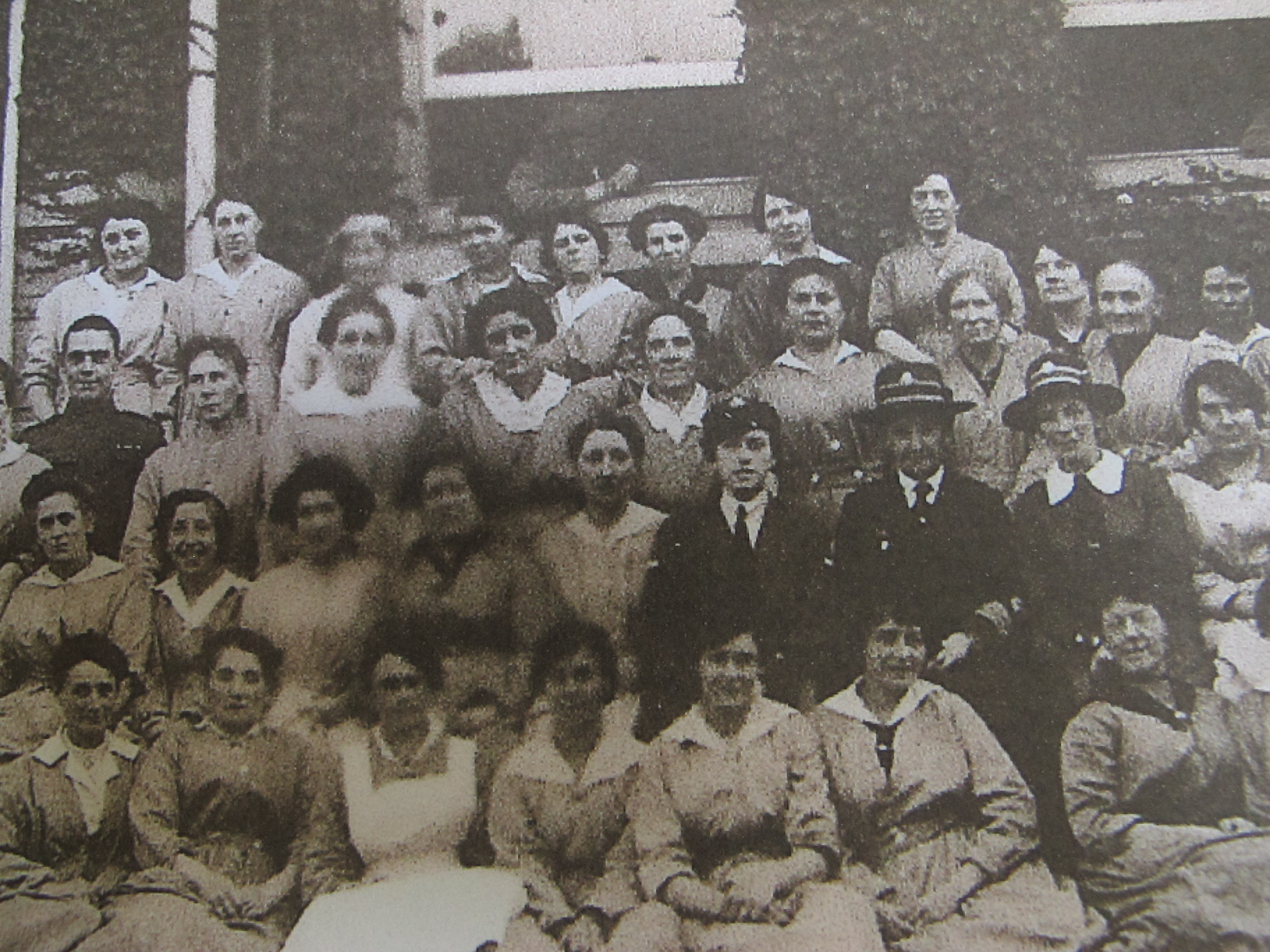
The other day while leading a tour around the estate that explored the role it played in WW1, a family showed me a picture of their relative, Daisy Simmonds, who is second from the left on the second row from the bottom.
IMG_3987
Daisy worked as a VAD (Voluntary Aid Detachment), a voluntary organisation of over 74,000 people, two-thirds women, who provided nursing services and worked as cooks, ambulance drivers, and took on other hands-on duties in military hospitals throughout the war. (http://www.redcross.org.uk/About-us/Who-we-are/Museum-and-archives/Resources-for-researchers/Volunteers-and-personnel-records is a good place to find out more). As a VAD Daisy worked at the Royal Pavilion hospital while also, apparently, maintaining a side career as a dancer at the Brighton Hippodrome. Thanks to the Dracott family for allowing me to show this photo here.
The ‘Pavilion Blues’ magazine (all available to download from http://www.images.brighton-hove-rpml.org.uk/assetbank-pavilion/action/browseItems?categoryId=1375&categoryTypeId=2&allCats=0&sortAttributeId=13&sortDescending=true&page=6&pageSize=25&filterId=-1) give a fascinating glimpse into everyday life in the Royal Pavilion Hospital for Limbless Men.
Pavilion_Blues_September_1917
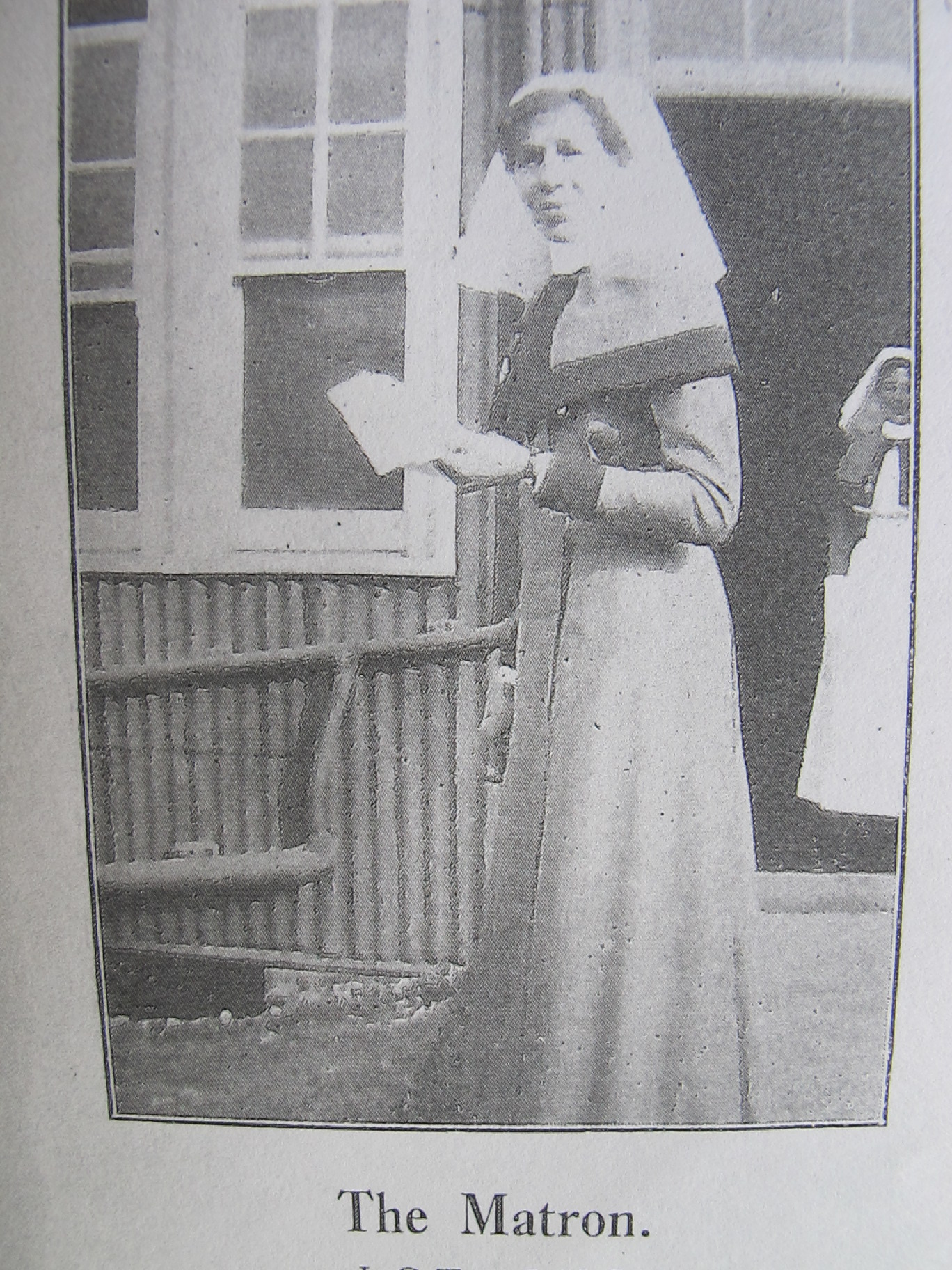
Jokes, poetry, stories, reports on the regular sports days and hat trimming competitions (there was a lot to trim on a 1916 hat) accounts of tea parties in local benefactors’ gardens, visits by the local music hall stars of the day (including rising star Charlie Chaplin) and drawings give a glimpse of the doughty spirit that seems to have prevailed. Women, a hidden presence in the Indian hospital, now seem to be everywhere, from the ‘young ladies’ who ran the canteen and are always being praised for their gentleness and charm to the matrons. This is ‘The Matron’.
IMG_3992
One ‘Miss Caruthers’, who, we’re told, ‘is a descendent of Scotsmen’, but born ‘on the English side of the border within sight of the beautiful Cumbrian lakes and mountains’. Miss Caruthers, a member of QAIMNS, spent her career in hospitals in Huddersfield, various London hospitals, Netley and Dartford before arriving in Brighton where, according to ‘Pavilion Blues’, ‘she is now devoting herself, making it home from home for us’.
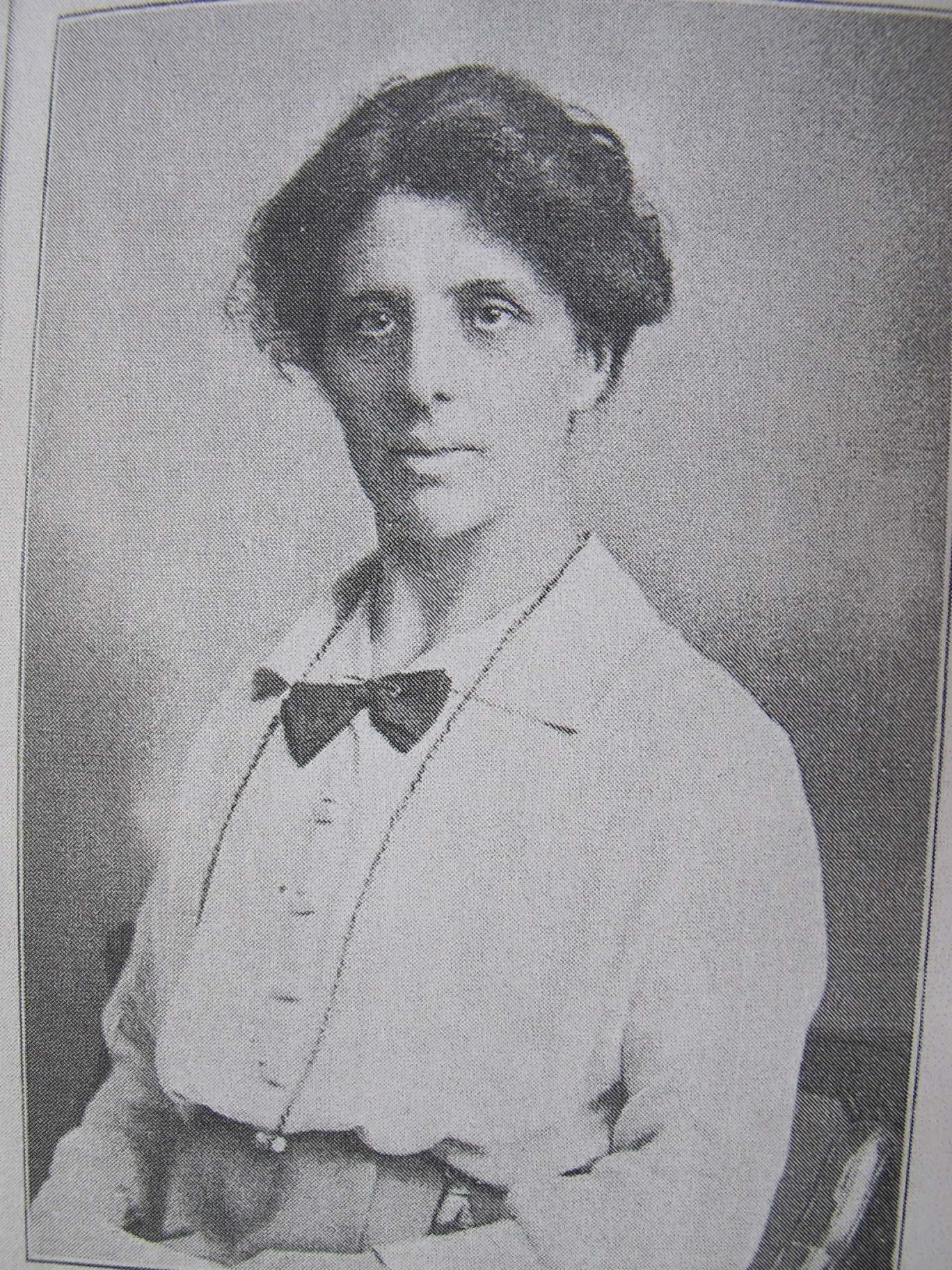
Another figure worthy of a whole page profile is ‘Mrs William Taylor’, who was in charge of the hospital post office. For any readers familiar with the Royal Pavilion, this was a small room immediately to the left of the King’s Apartments on the ground floor, in front of today’s buggy park and now obscured by a display cabinet. Not only was it a post office but a small cafe serving shrimp and watercress sandwiches, books, scones and tea.
IMG_3997
Mrs Taylor of Brunswick Square seems to have been another redoubtable presence, being the head of a club for laundry girls, working as a visitor for the Hove Relief of Distress Committee, the Prince of Wales’ Fund and being a ‘Woman Patrol’. These were volunteer policewomen who acted as aides to the established police. Without the powers of arrest they took on a more peace keeping role, patrolling local parks, public spaces and trying to nip would-be anti-social behaviour in the bud. Somehow, Mrs Taylor, described unsurprisingly as ‘a valuable organiser’ found the time to run the post office that, in the pre-texting and emailing world, must have been a lifeline to the injured men. ‘The efficient working of our post-office reflects the greatest credit on her and her able and zealous colleagues – to whom the boys are most grateful’, ‘Pavilion Blues’ says.
In Brighton, like most other towns, women were a rapidly growing presence in the working landscape. At the start of the war the number of British women in employment was almost three and a quarter millions. This had increased to almost 5 million by January 1918. Women could be seen engaged in agricultural work, transport and manufacturing. There are some wonderful pictures of women tram conductors and munitions workers in ‘Brighton in the Great war’ by Douglas D’Enno that can be browsed in the exhibition War Stories in Brighton Museum. This exhibition features the experience of several women and I will be telling some of their stories soon.