Bognor’s Swimming Champion

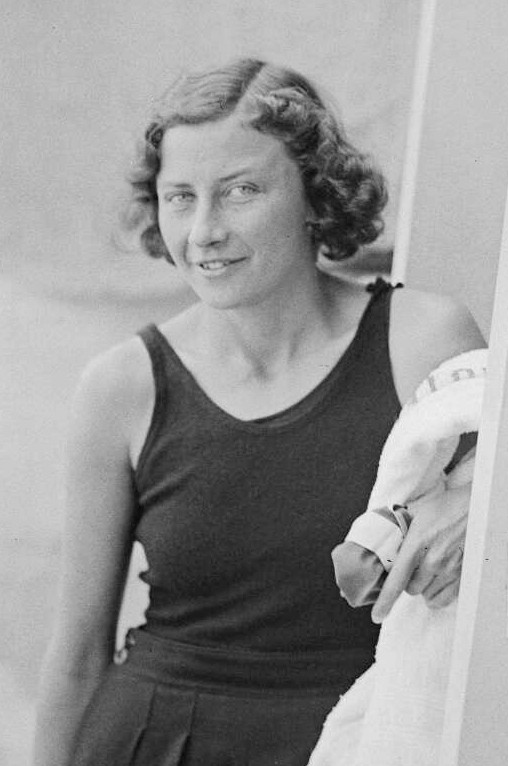
Joyce Cooper resting at the Domain Baths during the New South Wales Championships, 8 January 1934

How exciting has the Olympic swimming been?

As someone who spent a lot of last year having lessons on how to do front crawl (and a lot of this year trying to remember them) I’ve watched in awe.

Particular heroes amongst the swimming women are, of course,the USA’s Katie Ledecky with her two golds, one silver and one bronze to add to her previous seven Olympic gold medals plus twenty-one World Championship titles. This makes her the most decorated female swimmer ever.

Rebecca Adlington who has done such a great job commentating on the swimming and giving viewers an insight into the struggles and challenges the competitors must be experiencing, is herself Britain’s most successful female swimmer of all time with 17 major championship medals to her name..

A few years ago, however, it was a Sussex woman who had this acclaim. Joyce Cooper (1909 – 2002) remains one of the most decorated female swimmers this country has produced.

Born in Sri Lanka, Joyce settled in Bognor, West Sussex, with her family as a young girl. She carried on her habit of swimming in the Indian Ocean by taking regular dips in the Channel off Bognor. Not quite the same, but that’s dedication for you. However, it was only in 1925 when, staying in Eastbourne and seeing the strange sight of a woman doing the front crawl in a local pool that she thought ‘perhaps I’ll do that. This was a new stroke.’ and started to take up the sport seriously.

Just two years later Joyce was already of medal winning standard. At the 1927 European Championships in Bologna, her first major international event, she came close to winning gold when she tied with another swimmer in the 100m freestyle race. In the days before photo finishes and video re-play, the only way to establish a winner during an apparent draw was to rerun the race. As Joyce was unable to take part in the re-run due to a health issue, she was awarded the silver. She did take home gold from the competition, however, as part of the 4 x100m freestyle team.
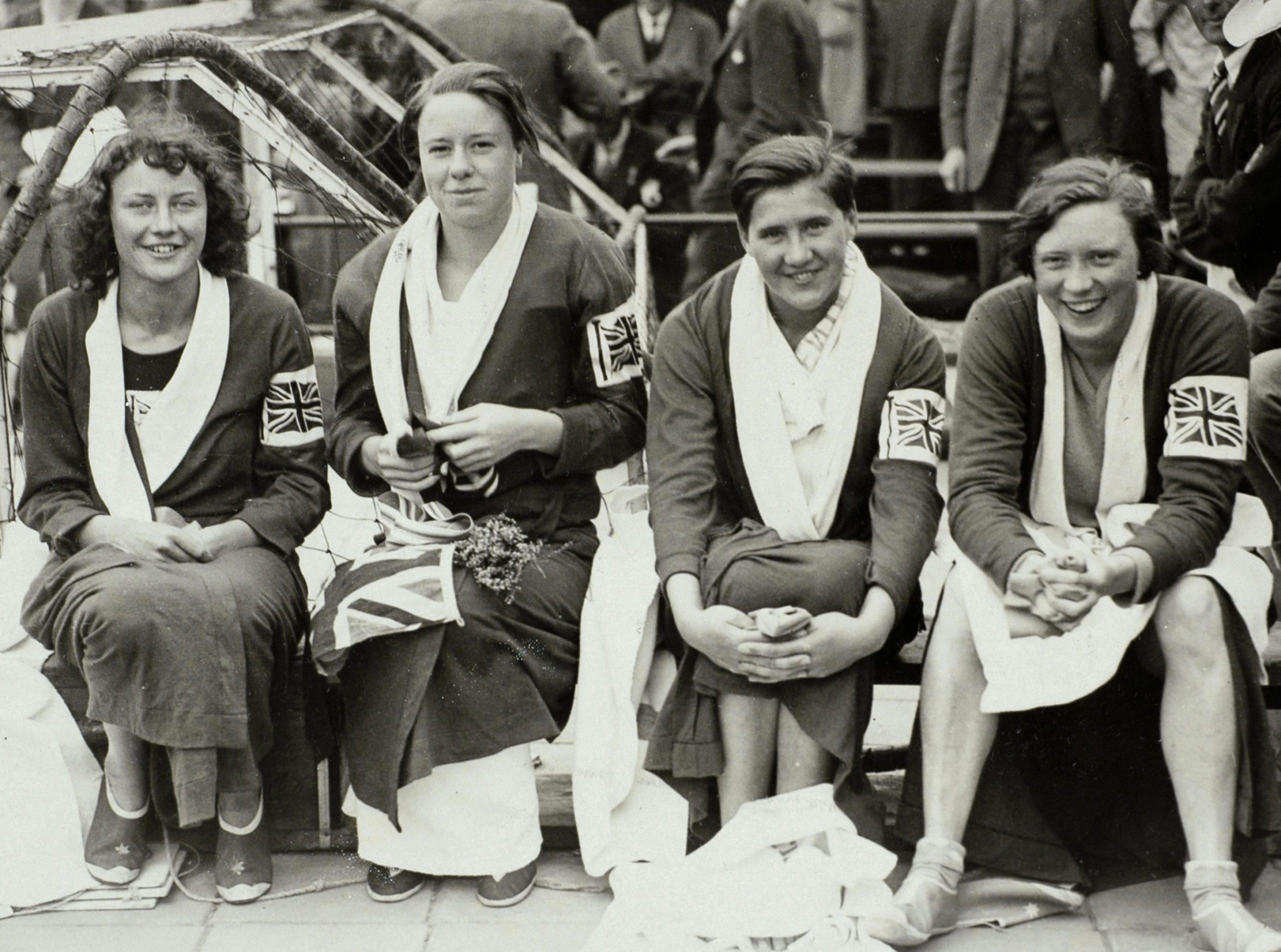
At the 1928 Amsterdam Olympics, the following year (pictured above, L- R Joyce, Ellen King, Cissie Stewart, fellow Sussex woman Iris Vera Tanner from Eastbourne), hopes were high for the British team. Numbers of female competitors had doubled since the last Olympics. For the first time, the swimmers wouldn’t be hampered by ungainly and heavy, knee-length, woollen swimming costumes – which must have felt like swimming in pyjamas -, although long robes on the journey to and from the pool were still insisted upon. Joyce didn’t disappoint and won two bronze medals and a silver for Great Britain.

In a 2011 programme with the BBC World Service, ‘Lady Swimmers of the 1920s’, you can hear Joyce talk to historian Anita Tedder (the interview dates from 15 years earlier) briefly about her career and her experience of the Amsterdam Olympics. Two other women from the British team were also interviewed, Jean McDowell who had been spotted swimming in a North Berwick swimming pool by a coach who told her parents he could make a world champion out of her, and fellow Scot, Sarah ‘Cissie’ Stewart (1911 – 2008) from Dundee. Cissie came from a sporting family. Her father was a footballer and her sister was another swimmer. It’s a very short but interesting listen and gives insight into the difficulties women faced if they wanted to take swimming seriously, such as segregated swimming sessions in pools. How hard it must have been fitting your work and care obligations around the paltry ‘Ladies’ Times’ in the local pool. The interviews also give us a sense of the glamour the media invested in the swimming team. The interview can be heard here:

https://www.bbc.co.uk/programmes/p047sw89

It was at the inaugural British Empire Games in 1930 in Canada, however, where Joyce, representing England, really got into her stride. In Hamilton she won an incredible three gold medals, coming top in three of the four individual women’s titles, topping this with a fourth gold as part of the 4 ×100 yard relay team. At the European Championships in Paris the following year Joyce went on to add three silvers and a bronze to her tally, and in the Los Angeles Olympics of 1932 she won a bronze medal and broke the world record in the heats for the 100m backstroke.

Joyce was a versatile swimmer who was as much at home swimming back stroke as front crawl and equally comfortable swimming long distances, winning many long distance swimming championships at the same time as her international successes. A woman of many talents, she also worked as a tailor and taught ballroom dancing. In 1934 she married another Olympian, rower John Badcock. Their eldest son, Felix Badcock, also became a medal winning rower.

Although not a household name today, Joyce’s achievements are particularly impressive when you consider that in her youth swimming wasn’t as accessible for women as it is today. Not only was swimwear generally designed for modesty not speed, but most pools only offered segregated bathing times with women having to wait until the appointed ‘ladies day’ to be able to practise.

A worthy inductee in the International Swimming Hall of Fame in 1996, the incredible Joyce Cooper died in Chichester in 2002.

(Part of this post was originally published as a Royal Pavilion & Museums Trust blogpost in response to the ‘First Women’ exhibition in Brighton Museum in 2020. This exhibition comprised a collection of 100 portraits by photographer Anita Corbin of women who were first in their field of achievement. To accompany the exhibition 100 blog posts looking at Sussex women from history were produced.

Link to original post: https://brightonmuseums.org.uk/discovery/history-stories/happy-birthday-joyce-cooper-champion-swimmer/.

More blog posts as part of this series here: https://brightonmuseums.org.uk/about-us/culture-change/100-pioneering-women-of-sussex/

The 100 Women exhibition is now online here: https://firstwomen.brightonmuseums.org/

Dr Priscilla Noble-Mathews, a West Sussex Hero

Dr Priscilla N-M,

Lock-down, semi lock-down, are-we-are-aren’t-we-in-lock-down, holidays cancelled, special occasions called off, queuing for shops, remembering your mask, furlough-furlough-furlough, the last few months have been challenging and we are having to quickly make up and adopt new etiquettes, manners and norms to negotiate this uncertain new world.

Having written 60 profiles of pioneering women with Sussex connections for the Brighton Museum website to accompany the incredible exhibition 100 First Women by Anita Corbin, I’ve found myself wondering how some of the women I wrote about – for the main, doughty characters who were good at taking things in their stride and decimating obstacles – would be going about present times.  Doctors who, virtually single-handedly, set up women’s hospitals in the face of an unbelieving medical establishment; social campaigners who, through sheer hard work and self-belief, pushed marginalised ideas into the mainstream, artists who wrestled with poverty and hardship to share their unique and beautiful visions, suffragettes and suffragists who stood up to jeers, heckles and violence to fight for our right to vote, sportswomen who put in the effort to fly the flag for their countries and women in sport. I’m sure many of them would have had wise things to say right now.

No more so than Dr Priscilla Noble-Mathews from Trotton, West Sussex.

Dr Noble-Mathews isn’t well-known (except, perhaps, for some parts of West Sussex, where she’s often been referred to as ‘a modern day saint’), she’s not a historical figure. I found out her story when my husband, a pharmacist who used to work in Midhurst, started a conversation with ‘an amazing woman came into the shop today….’

Here is Dr Noble-Mathews’ story lifted from my post on the Brighton Museum blog of  24th March, 2020:

By the way, if you don’t want to read all of it, just take this thought, in Dr Noble-Mathews’s words, describing one of the spurs to her becoming a first response paramedic….’….because I was afraid of it, it was something that I had got to do and get over.  If there’s something you’re afraid of the best way to conquer it is to go down into the fear.’  

Dr Priscilla Noble-Mathews, Doctor, Emergency First Response Paramedic, Founding Member of South East Coast Immediate Care Scheme. 

Dr priscilla N-M receiving her Humane Society award - we have permission to use this but must thank SIMCAS

Dr Priscilla Noble-Mathews, who died aged ninety in 2017 after a lifetime of service and dedication to her patients and local community, was a popular and much loved figure around Trotton, Midhurst, West Sussex, and further afield.  As a founding member of the South East Coast Immediate Care Scheme (SIMCAS) from when it began in the late 1980s, the Trotton resident carried a flashing blue light in her car and was known to drop everything and race off whenever she heard of a local accident, often being the first on the scene at car crashes, motorbike accidents and other serious incidents.  Affectionately referred to by locals as a ‘modern day saint’,  Dr Noble-Mathews kept a racing-driver type boiler suit hanging up and ready to go behind her door, and – even in her late eighties – was ready to set off in any weather, at any time of the day or night, sometimes in a helicopter, to dispense the all-important first-on-the-scene care.  As remembered in her obituary in The Times ‘Noble-Mathews thought nothing of scrambling into the wreckage of vehicles to tend to the injured and dying.’

In 2000, Dr Noble-Mathews, who had worked as a GP in Steyning and at the King Edward Hospital in Midhurst, as well as in hospice and palliative care, received a Royal Humane Award alongside the crew of a Sussex Police Helicopter for the heroic rescue of a young girl who had slipped on rocks and had been sighted drifting in the sea 50 yards off the beach in blustery weather at Littlehampton.  As the SIMCAS website recounts: ‘On arrival, the victim was lying motionless in the water and prompt action was needed. It was agreed that although highly dangerous they would take the risk and hover the aircraft on the water so that the paramedic could grab the child from the waves. Having done this, both medical personnel worked to resuscitate her whilst en route to the local hospital. Happily in spite of her ordeal, the young girl has made a full recovery.’  Dr Noble-Mathews later told the BBC that it was the first day in service of the brand new police helicopter and that, as it was designed for land operations, getting it close enough to pluck the girl out of the water by her coat was not an easy – or particularly safe – manoeuvre.

Dr Priscilla N-M, receiving her award with the helicopter and paramedic crew - we can use this image but must thank SIMCAS

Above – Dr Noble-Mathews receiving a Royal Human Award, 2000

For Dr Noble-Mathews, saving lives may have been all in a day’s work, but she only turned to medicine relatively late in her life.  She had already worked as a barrister and at the War Office before deciding, in her thirties, to train as a doctor. With most universities refusing to accept her on the grounds of age, she was eventually taken on by the University of Southampton.  The journey was far from straightforward, however, as she first had to pass the relevant ‘O’ and ‘A’ Levels in Science, which she cheerfully went off to Crawley Tech to study for.  Just shy of fifty, at a time when many people are thinking about winding their careers down, Dr Noble-Mathews graduated and embarked on her medical career in 1976.

After writing to the BBC to respond to a debate on Radio Four about the ordination of women priests in 2010, Dr Noble-Mathews was considered an interesting subject for a radio programme in her own right, and was invited to chat to Eddie Mair and Jennifer Tracey on Radio Four’s ‘iPM’ show broadcast on Christmas Day that year. In a fascinating half hour in which she described being a homesick evacuee during the war, being a badly behaved teenager and her Catholic faith, Dr Noble-Mathews claimed that one of her motivations for joining SIMCAS had been fear.  She’d seen so many crashes as she’d driven around West Sussex for work ‘Most doctors, I think I’m right in saying, certainly in those days, would rather do anything than go to a crash. It’s a completely different environment, you feel really quite impotent if you haven’t got the wherewithal and the know how with what to do.  I think there’s a certain amount of fear as a result of that.  And so I decided that because I was afraid of it, it was something that I had got to do and get over.  If there’s something you’re afraid of the best way to conquer it is to go down into the fear.’ 

As a member of SIMCAS Dr Noble-Mathews went on to train ambulance crews, volunteer to run courses training paramedics in Romania, and teach immediate care providers on Pre Hospital Emergency Care courses.

Dr Noble-Mathews, an inspiration for so many, was inspired herself by her Catholic faith and was briefly a nun.  While working as a doctor, she managed to study for degrees in Theology gaining a Bth (Hons) in 2007 at St John’s Seminary, Wonersh, and an MA in Theology at the University of Wales in 2010.

A friend of Dr Noble-Mathews,  Afifah Hamilton, a Consulting Nutritionist, Medical Herbalist, and owner of Rosemary Cottage Clinic in Bognor Regis no doubt spoke for many when she wrote in ‘My Obituary for a Saint’ on her blog in October 2017  ‘Priscilla reminds us of how much one person can achieve in a lifetime. Her example is both inspiring and humbling, for this gentle, reverent lady never sought praise for her accomplishments but was just happy to truly serve.’

SIMCAS is a charity which provides specially trained and equipped doctors and nurses, giving their time voluntarily, to serious collisions and major incidents in the South East, and is part of the British Association for Immediate Care (BASICS). Volunteers work with the emergency services but aren’t funded by the NHS, with all equipment provided by donations:  http://www.simcas.org.uk

With many grateful thanks to Dr Rowley Cottingham, Chairman of SIMCAS, and to Afifah Hamilton, Rosemary Cottage Clinic, Bognor Regis www.rosemarycottageclinic.co.uk